Which States Have Castle Doctrine?
The majority of U.S. states, more than 30, have some form of castle doctrine written into statute, though the details vary considerably in what they cover and how strong the protection actually is.
(For a full breakdown of what castle doctrine actually means and how it works, see our guide: castle doctrine.)
Below is a state-by-state snapshot of how castle doctrine protection is structured across the country. "Extends to vehicle" and "extends to workplace" indicate whether the presumption of reasonableness reaches beyond the home itself. "Presumption of reasonableness" indicates whether the law shifts the burden to the prosecution, rather than simply removing the duty to retreat.
|
State |
Statute |
Extends to Vehicle |
Extends to Workplace |
Presumption of Reasonableness |
|
Alabama |
Ala. Code § 13A-3-23 |
Yes |
Yes - orange |
Yes |
|
Alaska |
Alaska Stat. § 11.81.335 |
No |
No - gray |
No |
|
Arizona |
Ariz. Rev. Stat. § 13-411 |
Yes |
Yes - orange |
Yes |
|
Arkansas |
Ark. Code § 5-2-620 |
Yes |
Yes - orange |
Yes |
|
California |
Cal. Penal Code § 198.5 |
No |
No - gray |
Yes |
|
Colorado |
Colo. Rev. Stat. § 18-1-704.5 |
No |
No -gray |
Yes |
|
Florida |
Fla. Stat. § 776.013 |
Yes |
Yes -orange |
Yes |
|
Georgia |
Ga. Code § 16-3-23 |
Yes |
Yes -orange |
Yes |
|
Idaho |
Idaho Code § 19-202A |
No |
No - gray |
Yes |
|
Illinois |
720 ILCS 5/7-2 |
No |
No - gray |
No |
|
Indiana |
Ind. Code § 35-41-3-2 |
Yes |
Yes - orange |
Yes |
|
Iowa |
Iowa Code § 704.2A |
No |
No - gray |
Yes |
|
Kansas |
Kan. Stat. § 21-5223 |
Yes |
Yes - orange |
Yes |
|
Kentucky |
Ky. Rev. Stat. § 503.055 |
Yes |
Yes - orange |
Yes |
|
Louisiana |
La. Rev. Stat. § 14:20 |
Yes |
No - gray |
Yes |
|
Michigan |
Mich. Comp. Laws § 780.951 |
Yes |
No -gray |
Yes |
|
Mississippi |
Miss. Code § 97-3-15 |
Yes |
Yes -orange |
Yes |
|
Missouri |
Mo. Rev. Stat. § 563.031 |
Yes |
Yes - orange |
Yes |
|
Montana |
Mont. Code § 45-3-103 |
No |
No - gray |
No |
|
Nevada |
Nev. Rev. Stat. § 200.120 |
No |
No - gray |
Yes |
|
New Hampshire |
N.H. Rev. Stat. § 627:4 |
No |
No - gray |
No |
|
North Carolina |
N.C. Gen. Stat. § 14-51.2 |
Yes |
Yes - orange |
Yes |
|
North Dakota |
N.D. Cent. Code § 12.1-05-07 |
No |
No - gray |
No |
|
Ohio |
Ohio Rev. Code § 2901.09 |
Yes |
No - gray |
Yes |
|
Oklahoma |
Okla. Stat. tit. 21, § 1289.25 |
Yes |
Yes - orange |
Yes |
|
Pennsylvania |
18 Pa. Cons. Stat. § 505 |
Yes |
No - gray |
Yes |
|
South Carolina |
S.C. Code § 16-11-440 |
Yes |
Yes - orange |
Yes |
|
South Dakota |
S.D. Codified Laws § 22-16-35 |
No |
No - gray |
No |
|
Tennessee |
Tenn. Code § 39-11-611 |
Yes |
Yes - orange |
Yes |
|
Texas |
Tex. Penal Code § 9.31–9.32 |
Yes |
Yes - orange |
Yes |
|
Utah |
Utah Code § 76-2-405 |
No |
No - gray |
Yes |
|
West Virginia |
W. Va. Code § 55-7-22 |
Yes |
No - gray |
Yes |
|
Wisconsin |
Wis. Stat. § 939.48 |
No |
No - gray |
Yes |
This isn't every state, and coverage details shift as legislatures amend these statutes, so always confirm the current language for your own state rather than relying on a summary table alone.
How Far the Protection Reaches
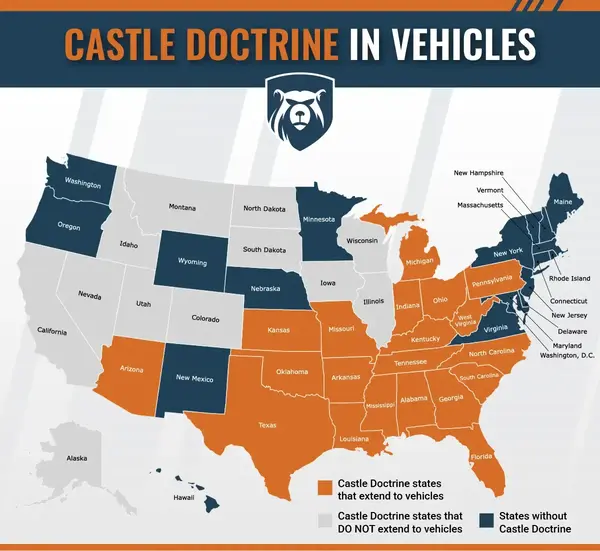
Castle doctrine states generally sort into three tiers, based on how far the "castle" extends beyond the home's four walls.
Dwelling only. States in this group limit the presumption of reasonableness strictly to the home itself, sometimes including attached structures like a garage, but not extending it to a vehicle or a place of business. California and Colorado are examples here: their statutes are built specifically around the residence, and courts haven't extended that presumption to a car or workplace situation.
Dwelling plus vehicle. A larger group of states extends the same protection to an occupied vehicle, treating a car much like an extension of the home for purposes of the presumption. Ohio, Michigan, and Louisiana fall into this category. If you're forcibly confronted inside your own vehicle in these states, the same shifted burden that applies at home generally applies there too.
Dwelling plus vehicle plus workplace. The broadest category extends protection to all three: home, vehicle, and place of business. Texas, Florida, Georgia, and North Carolina are among the states that take this wider approach, reflecting a legislative choice to treat "occupied space you have a legal right to be in" more expansively than just the residence.
Where your state falls in this breakdown matters enormously in practic. Two people who take an identical defensive action inside their own car could see completely different legal starting points depending on which side of a state line they're standing on.
States With No Castle Doctrine Statute
Not every state has codified castle doctrine into a standalone statute.
States like Alaska, Illinois, Montana, New Hampshire, North Dakota, and South Dakota don't have a dedicated castle doctrine law extending a presumption of reasonableness the way the states above do.
That doesn't mean self-defense in the home is unprotected in those states. The analysis falls back to ordinary self-defense law: whether the force used was reasonable under the totality of the circumstances, evaluated without the benefit of a legal presumption in the defender's favor.
Some of these states retain a limited duty to retreat outside the home, while others recognize a no-retreat rule for the home through case law rather than statute, even without a formal castle doctrine provision on the books. If you live in one of these states, it's especially important to understand exactly how your state's self-defense framework works, since you won't have the procedural advantage that a presumption of reasonableness provides elsewhere.
Castle Doctrine by State: Five Closer Looks
Castle Doctrine Texas
Texas has one of the broadest castle doctrine frameworks in the country, codified at Texas Penal Code §§ 9.31 and 9.32. The presumption of reasonableness extends not just to the home, but to an occupied vehicle and place of business as well, meaning the same shifted burden that protects you at home generally follows you into your car or workplace under Texas law.
To claim the presumption, the person against whom force was used must have been entering or attempting to enter unlawfully and with force, and the person defending must not have provoked the intruder. Texas law also removes the duty to retreat broadly, not just inside the home, which is one reason the state is frequently cited alongside its stand your ground provisions.
One notable limit: the presumption doesn't apply if you knew or had reason to believe the person entering was a law enforcement officer performing official duties, or if you were engaged in criminal activity at the time, beyond a minor traffic offense. Texas's protection is broad, but it's not unconditional, and prosecutors will look closely at whether either of these carve-outs applies before a self-defense claim gets far.
Castle Doctrine Florida
Florida's castle doctrine is codified at Florida Statutes § 776.013, and like Texas, it extends the presumption of reasonableness to the home, an occupied vehicle, and, in many circumstances, a place of business. Flori presumes that a person has a reasonable fear of death or great bodily harm when someone unlawfully and forcibly enters, or has entered, a dwelling, residence, or occupied vehicle.
Florida also provides civil immunity in many justified self-defense cases, not just criminal protection, which sets it apart from states where the two are handled separately. That civil immunity provision has made Florida's law a frequent reference point in national self-defense law discussions.
The notable limit here involves cohabitants and family members: the presumption generally doesn't apply if the person entering has a legal right to be in the dwelling, such as an owner, lessee, or someone with a custody or visitation right to a child or grandchild residing there, even amid an ongoing domestic dispute.
Castle Doctrine California
California's approach is considerably narrower than Texas or Florida's. Its home protection statute, California Penal Code § 198.5, applies specifically to the residence and creates a presumption of reasonable fear when someone unlawfully and forcibly enters a home while a resident is present and knows or has reason to know the entry is occurring.
Unlike the broader states above, California's statute does not extend that presumption to an occupied vehicle or a workplace. Self-defense in those settings is evaluated under California's general self-defense standards instead, which don't carry the same shifted burden.
The notable limit in California involves the residency requirement itself: the presumption applies only when the resident actually knew or had reason to know of the unlawful entry, and it doesn't extend to force used against a member of the household or someone with a legal right to be there, similar to the cohabitant exclusion found in most other states' laws.
Castle Doctrine Ohio
Ohio's castle doctrine is set out in Ohio Revised Code § 2901.09, and it extends the presumption of reasonableness to both the home and an occupied vehicle, though not specifically to a place of business the way Texas or Florida's laws do.
Ohio's statute presumes a person acted in self-defense when using force against someone unlawfully entering or attempting to enter their residence or vehicle. Ohio also removed its general duty to retreat statewide in 2021, meaning the no-retreat principle in Ohio isn't limited only to the home and vehicle, it applies more broadly to any place a person is lawfully present.
The limit in Ohio centers on the same aggressor and lawful-occupancy conditions found elsewhere: the presumption doesn't apply if the person claiming self-defense was engaged in, or attempting to commit, a criminal offense at the time, or if they were the initial aggressor in the encounter.
Castle Doctrine North Carolina
North Carolina's castle doctrine, codified at North Carolina General Statutes § 14-51.2, is among the more expansive versions in the country, covering the home, an occupied vehicle, and a workplace. The statute creates a presumption that a person held a reasonable fear of imminent death or serious bodily harm when force was used against someone who unlawfully and forcibly entered, or was in the process of unlawfully and forcibly entering, one of those three locations.
North Carolina's law also extends the presumption to situations where an intruder has already unlawfully entered and remains inside, not just at the moment of forced entry itself, which is a slightly broader trigger than some other states use.
The notable limit involves removal or restraining orders: the presumption doesn't apply against someone who has a legal right to be in the home, such as an owner or lawful resident, including in situations involving a spouse or family member subject to a domestic dispute but not a restraining order barring their presence.
How to Check Your Own State
The table and state breakdowns above give you the general shape of castle doctrine across the country, but statutes get amended, and the details that matter most, whether your state covers a vehicle, whether it includes a workplace, whether a presumption of reasonableness applies, can shift with a single legislative session.
Before relying on any summary, including this one, always confirm the current language of your own state's law.
Our state-by-state gun law pages break down the specific self-defense statutes, carry laws, and castle doctrine provisions for each state we cover, and they're kept current as legislation changes.
Understanding the law in advance is one part of being prepared. The other part is having legal protection in place before you ever need to rely on any of this. When the waters surrounding whether you actually had the proper authority get murky, you need the criminal and civil protection members of Right To Bear gain access to through our acquired CCW insurance policy, along with all of our bespoke benefits.
You can read more about what that protection includes on our CCW insurance page.
FAQ
Which U.S. states have castle doctrine laws?
Most states recognize some form of castle doctrine, but the protections vary by state.
How do castle doctrine and stand-your-ground laws differ?
Castle doctrine generally applies to the home, while stand-your-ground laws remove the duty to retreat more broadly.
What are the legal requirements for using deadly force under castle doctrine?
Deadly force generally requires a reasonable belief that it is necessary to stop an imminent threat of death or serious bodily harm.
Does castle doctrine apply to vehicles and workplaces?
Some states extend castle doctrine protections to vehicles, workplaces, or other locations.
Does castle doctrine provide protection from civil liability?
Some states provide civil immunity when force is legally justified under castle doctrine.
What should new homeowners know about castle doctrine?
Homeowners should understand when castle doctrine applies, what force is permitted, and whether their state provides a presumption of reasonable fear.
How does the duty to retreat compare with castle doctrine by state?
Castle doctrine generally removes the duty to retreat inside the home. Some states extend that protection through stand-your-ground laws.
What is the history and origin of castle doctrine in common law?
Castle doctrine comes from the common-law principle that people should not have to retreat from their homes before defending themselves.
Which states have no duty to retreat inside the home?
Most states do not require retreat inside the home, but the specific protections vary by state.
Can a guest claim castle doctrine in someone else's home?
Some states extend castle doctrine protections to lawful guests or occupants, depending on the circumstances.
What recent changes have been made to self-defense laws?
Self-defense laws can change through new legislation and court decisions, so current state law should be checked.
Does castle doctrine apply to renters and apartment dwellers?
Generally, yes. Renters may receive castle doctrine protections in their residence, depending on state law.