
- 96% believe castle doctrine protection should extend beyond the home
- 79% describe themselves as at least somewhat familiar with their state's law
- 30% are unsure whether their state has a Stand Your Ground law
- 83% name criminal prosecution or civil lawsuits as their top concern
Those numbers come from a survey that was run between July 15 and August 4, 2026 and featured in our From The Den newsletter delivered to Right To Bear Members .
The results demonstrate that many law-abiding gun owners know where castle doctrine should apply, but far less certain about where it actually does.
Readers Want Protection to Reach Further Than the Law Does
The gap between belief and law is widest, and it starts with a simple question: does castle doctrine end at your front door?
Almost none of the readers we surveyed think it should:
- 91% said protection should extend to an occupied vehicle
- 87% said it should cover a temporary residence, like a hotel room or a short-term rental
- 58% extended it to the workplace
- 9% said protection should be limited to the home itself
A car, a hotel room, a rental unit: these all function as a kind of temporary "home" in the moment you're in them, and the argument for treating them the same way the law treats your house has real intuitive pull.
Whether castle doctrine follows you into your car depends entirely on which state you're standing in.
Some states, Texas among them, build the vehicle directly into their castle doctrine framework: the same presumption of reasonableness that applies inside your home extends to an occupied vehicle and even a place of business.
Other states draw the line much more narrowly. California's home protection statute, for example, is written specifically around the residence, and courts have not extended it to a car in the same way.
This means the same defensive action, in the same kind of moment, can be legally presumed reasonable in one state and left for a jury to sort out in another. If you carry, or keep a firearm in your vehicle, it's worth finding out specifically which category your state falls into rather than assuming the broader definition applies.
Our full breakdown of how castle doctrine works, and where its boundaries actually sit, is in What Is Castle Doctrine Law?
Knowledge Is Broad but Shallow
Our readers believe they aren't uninformed, just less informed than they wish they were.
- 79% described themselves as at least somewhat familiar with their state's castle doctrine law, but;
- 34% said they'd actually researched it in detail
- 15% admitted their understanding amounts to an assumption that it covers the home, without knowing much beyond that
- 6% said they weren't familiar with it at all.
Set that against a separate finding from the same survey: 30% of these same readers don't know whether their state has a Stand Your Ground law. That's nearly a third of a group that, by its own self-report, considers itself reasonably well-versed in self-defense law.
This is arguably the most defensible finding in the entire survey. Every respondent here is a subscriber to a self-defense legal newsletter, someone who has actively opted in to receiving this kind of information. If anything, that self-selection should push familiarity scores up, not down.
A general population sample would likely show an even wider gap between confidence and actual knowledge. When a survey's sample bias works against a finding rather than for it, that finding tends to hold up.
The Fear Is Legal, Not Physical
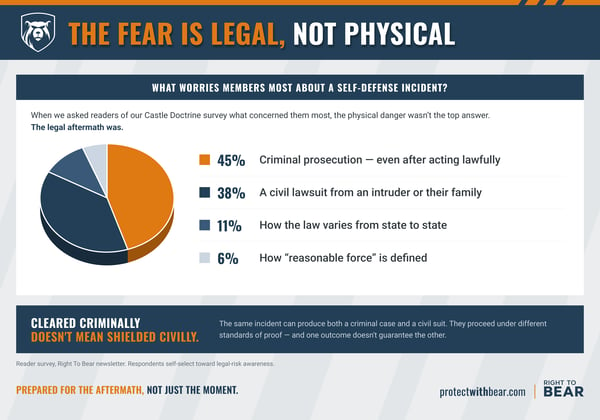
When we asked readers what concerned them most about a hypothetical self-defense incident, the physical danger wasn't the top answer. The legal aftermath was.
- 45% said their biggest fear was facing criminal prosecution even after acting lawfully
- 38% pointed to the possibility of a civil lawsuit from an intruder or their family
- 11% cited uncertainty over how the law varies from state to state
- 6% said their biggest concern was simply not knowing how "reasonable force" is defined
There is some obvious bias here to account for. Readers of a self-defense legal protection newsletter are, almost by definition, primed to think about legal exposure.
Still, the underlying concern is a real one. Being cleared of any wrongdoing in a self-defense case doesn't automatically shield you from a civil suit over the same incident; the two proceed under different standards of proof, and one outcome doesn't guarantee the other.
We cover how that works in more detail in Can You Be Sued for Self-Defense?
Nearly a Third Don't Know Their Own State's Law
Asked directly whether their state has a Stand Your Ground law, 57% answered yes, 13% answered no, and 30% said they weren't sure.
Of every finding in this survey, this is the one with the clearest, most immediate fix. Unlike broader legal literacy, which takes real time to build, this is a single fact about a single state, and it's resolvable in one search.
If you fall into that 30%, our Stand Your Ground Laws guide breaks it down state by state, and it's worth five minutes of your time to go check where you stand.
What This Means If You Carry
A few practical takeaways, drawn from where readers' confidence and the actual law tend to diverge most:
- Confirm whether your state extends castle doctrine beyond the dwelling. Don't assume a vehicle, hotel room, or workplace is automatically covered. That varies by state, and the difference matters if you're ever in a position to rely on it.
- Check your Stand Your Ground status directly. Nearly a third of readers who consider themselves informed didn't know this about their own state. It's a five-minute fix, not a research project.
- Understand that criminal and civil exposure are separate proceedings. Being cleared criminally doesn't close the door on a civil suit, and readers' instinct to worry about both, not just one, is the correct instinct to have.
Full Survey Results
Full response breakdown for each question, presented as surveyed.
Survey Question: Where should castle doctrine protection extend?
|
Location |
Readers who believe it should apply |
|
Occupied vehicle |
91% |
|
Temporary residence (hotel, rental) |
87% |
|
Workplace |
58% |
|
Home only |
9% |
Survey Question: How familiar are you with your state's castle doctrine law?
|
Response |
Share of readers |
|
At least somewhat familiar |
79% |
|
Researched in detail |
34% |
|
Assume it covers the home, no further detail |
15% |
|
Not familiar at all |
6% |
Survey Question: What concerns you most about a hypothetical self-defense incident?
|
Concern |
Share of readers |
|
Criminal prosecution despite acting lawfully |
45% |
|
Civil lawsuit from an intruder or their family |
38% |
|
State-to-state variation in the law |
11% |
|
Defining "reasonable force" |
6% |
Survey Question: Does your state have a Stand Your Ground law?
|
Response |
Share of readers |
|
Yes |
57% |
|
No |
13% |
|
Unsure |
30% |
Our Survey Methodology
This survey was distributed to subscribers of the Right To Bear newsletter and collected responses between July 15 and August 4, 2026.
Respondents self-selected into the survey, meaning the sample reflects an audience already engaged with self-defense legal content rather than the general population of gun owners or the public at large. Findings should be read as representative of this readership, not as a national or general-population estimate.
What We're Publishing Next
We also asked readers what they'd like to see covered next.
Two topics came back nearly tied:
- 40% want a deeper look at defending someone other than yourself
- 38% want to understand how prosecutors evaluate a self-defense claim before deciding whether to bring charges
Given how close the two ran, we're treating this as a two-part series rather than picking a single winner. We’ll cover both of these topics in future articles. At Right To Bear, our mission to offer legal protection for our members works hand in hand with educating and providing necessary resources to help understand the 2A world around us.
If you carry regularly, understanding where the law does and doesn't back you up is only half the equation. The other half is having the right protection in place before you ever need it.
Read more about what that coverage actually includes on our CCW insurance page.
If you aren’t already a Right To Bear member, sign up today to receive educational material like this in your inbox and be a part of the conversation to better inform yourself and others.
Individual plans start at just $19/month and give you access to benefits like criminal and civil legal protection, a 24/7/365 emergency and non-emergency attorney-answered hotline, full access to our newsletter and educational library, and much more.
Join Right To Bear today and become a part of the conversation.