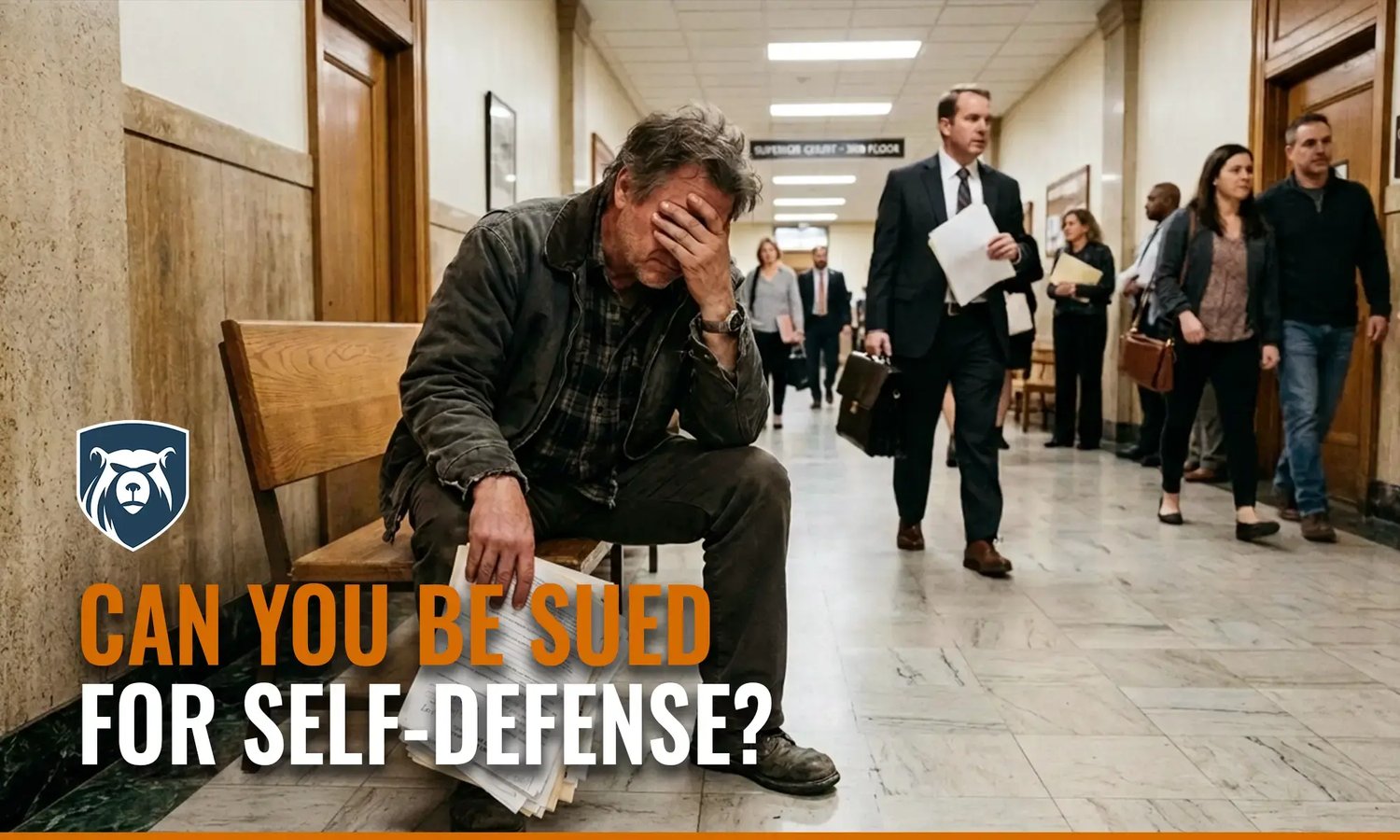
Yes. You can be sued for self-defense even if you are never charged with a crime, and even if a criminal court clears you entirely. This surprises a lot of people, and understandably so. If your actions were justified, it seems reasonable to assume the legal exposure ends there but it does not and the legal fees will only continue to roll in.
Want more content like this?
Stay connected with the latest news, updates, and special offers. Join our community by signing up for our newsletter today!
Criminal and civil courts operate as two separate systems with two separate standards, which means a self-defense incident can trigger two distinct legal battles: one for your freedom, and one for your financial survival.
Criminal vs Civil Court in Self-Defense Cases
The difference between civil and criminal court in self-defense cases is the foundation for everything else in this article.
- Criminal court exists to determine whether a crime occurred
- Civil court exists to determine whether financial damages are owed
These are independent questions, decided independently, which means a criminal acquittal does not prevent a civil lawsuit from moving forward.
Who files the case?
In criminal court, the prosecutor files on behalf of the state. In civil court, the injured party or the surviving family members file on their own behalf, seeking financial compensation rather than punishment.
The burden of proof is different too, and this difference matters enormously.
Criminal court requires proof beyond a reasonable doubt, a high standard designed to protect against wrongful conviction.
Civil court requires only a preponderance of the evidence, meaning something is more likely true than not, roughly a 51% threshold. This lower civil standard is precisely why civil liability after self-defense remains a real risk even after a clean criminal outcome.
You are facing two different tracks of exposure, governed by two different rules.
Why You Can Be Sued Even If the Shooting Was Ruled Self-Defense
A finding of legal justification in criminal court does not automatically block a civil lawsuit. Civil courts conduct their own independent evaluation of reasonableness, and they are not bound by what a criminal court or prosecutor decided.
Explore: Right To Bear Civil Defense Protection
Wrongful death lawsuits can be filed by surviving family members seeking compensation for funeral costs, lost income, and emotional damages. No criminal conviction is required for this type of claim to proceed.
Personal injury lawsuits can be filed if the individual involved survives, seeking compensation for medical bills, lost wages, and pain and suffering.
Allegations of excessive force are common in both types of civil claims. A plaintiff's attorney may argue that the force used was unreasonable given the circumstances, and because a civil jury applies the lower preponderance standard, the subjective interpretation of what was "reasonable" creates real risk, even in cases that seemed clear-cut at the time.
What Financial Exposure Looks Like After a Self-Defense Incident
The financial consequences of self-defense litigation can be severe even when you ultimately prevail. Consider what a defense can actually cost:
- Attorney fees ranging from $50,000 to $100,000 or more
- Court costs and filing fees
- Expert witness fees for ballistics, medical, or use-of-force specialists
- Deposition costs across multiple parties
- Potential civil judgments or settlements
- Wage garnishment or asset liens if a judgment is entered against you
Even successfully defending a lawsuit can be financially devastating. And here is the part that catches most people off guard: even when criminal charges are dismissed entirely, the financial fight may just be beginning.
See also: What Is a 2nd Amendment Lawyer?
Why Criminal and Civil Defense Protection Matters After a Self-Defense Incident
A self-defense incident can trigger criminal prosecution, a civil lawsuit, or both, sometimes simultaneously and sometimes one after the other. Each requires its own experienced legal representation, and defense does not stop the moment a criminal case concludes.
Civil litigation can last years beyond that point. Immunity hearings, where applicable, require skilled counsel to argue effectively. Civil motions and discovery demand their own defense strategy entirely separate from whatever happened in criminal court. The costs for all of this begin immediately, often before you have had time to process what just happened.
This is why Right To Bear's Criminal and Civil Defense Protection exist; to protect people who’re only guilty of utilizing the right to defend themselves. Your membership covers 100% of attorney fees for your legal defense in a covered self-defense incident, for both the initial case and any appeal, in criminal court and in civil court. You retain the ability to choose your own attorney rather than accept whoever is assigned to you.
This is not about reactive fear. It is responsible preparation and risk management, the same category of decision as training or secure storage, just applied to the legal aftermath instead of the moment itself.
Does Stand Your Ground or Castle Doctrine Prevent Civil Lawsuits?
Some states do provide a form of civil immunity tied to Stand Your Ground or Castle Doctrine protections, but that immunity is not automatic. In many jurisdictions, a separate immunity hearing is required before civil immunity is granted, and plaintiffs can challenge that immunity directly. The specifics vary significantly from state to state, which makes a one-size-fits-all assumption dangerous.
Even when statutory immunity exists on paper, someone still has to argue it on your behalf in front of a judge. That argument requires legal representation just like any other phase of the process. Civil immunity is a legal protection, not a self-executing shield.
What Happens If You Lose a Civil Self-Defense Lawsuit?
Losing a civil case can mean compensatory damages covering the plaintiff's quantifiable losses, and in some cases punitive damages intended to punish particularly egregious conduct. The long-term financial impact can include damage to your credit, wage garnishment, and in serious cases, asset seizure to satisfy the judgment.
The legal aftermath of a self-defense incident can extend for years past the moment the threat itself ended. Preparation has to account for both the courtroom and the financial consequences that follow it, not just one or the other.
How to Protect Yourself From Civil Liability After Self-Defense
Know whether you live in a duty to retreat or Stand Your Ground state, understand what civil immunity provisions exist where you live, and be aware of the statute of limitations that applies to civil claims in your jurisdiction.
Consider dedicated self-defense legal coverage:
Civil defense costs begin quickly, criminal and civil exposure frequently overlap, and immediate attorney access in the hours after an incident is critical to how everything that follows unfolds. Right To Bear's Criminal and Civil Defense Protection addresses both sides of post-incident litigation directly, covering criminal defense and civil lawsuit protection under the same membership. Legal readiness should exist before an incident occurs, not after a lawsuit has already been filed.
Get professional training:
Use-of-force training, de-escalation techniques, and proper post-incident documentation all reduce your risk going into a defensive situation. Training reduces risk. Legal protection manages the consequences that follow regardless of how well-prepared you were in the moment.
Get a Right To Bear membership:
The benefits extend well beyond criminal and civil defense alone. Members also have access to a 24/7/365 emergency attorney-answered hotline, firearm replacement coverage if your weapon is seized as evidence, lost wage protection to help offset income disruption during legal proceedings, expert witness coverage, and up to 40 counseling sessions for psychological support after a covered incident.
Every piece is designed around the same idea: a self-defense incident creates risk that extends well past the moment itself, and your protection should too.
Frequently Asked Questions
Can you be sued for self-defense if charges are dropped?
Yes. Civil cases proceed independently of criminal outcomes. A dismissal of criminal charges does not prevent a civil lawsuit from being filed or moving forward.
Can you be sued for shooting someone in self-defense?
Yes. Wrongful death or personal injury lawsuits may follow a self-defense shooting regardless of whether criminal charges are filed or how the criminal case is resolved.
How long after a self-defense incident can someone sue?
This depends on the statute of limitations in your state, which varies depending on the type of civil claim being filed. It is important to understand your state's specific timelines.
Does homeowners insurance cover self-defense lawsuits?
Often not. Homeowners' policies frequently exclude intentional acts, and a defensive shooting is considered an intentional act even when fully justified, which can leave you without the coverage you assumed you had.
Final Thoughts
You can be sued for self-defense even if you are never convicted of a crime. Civil lawsuits operate under a lower burden of proof and focus on financial damages rather than punishment, which means the legal fight can continue long after a criminal case has ended.
Responsible firearm ownership means preparing not only for the defensive moment itself, but for the criminal and civil legal battles that may follow it.
A Right To Bear membership exists for exactly this reality. It covers 100% of attorney fees for both your criminal and civil defense, for the initial case and any appeal, with the freedom to choose your own attorney instead of whoever happens to be assigned to you. Our 24/7/365 emergency attorney-answered hotline puts a real attorney on the phone the moment you need one, not days later when the damage from an early misstep is already done.
The benefits extend beyond the courtroom, with firearm replacement if your weapon is seized, lost wage protection if the legal process pulls you away from work, and counseling support if the weight of what happened follows you home.
Take a moment to evaluate whether you have adequate criminal and civil defense protection in place. The time to find out is before you ever need it, not after. Sign up for a Right To Bear membership today.
ONE WRONG MOMENT SHOULDN'T COST YOU EVERYTHING
Carry with confidence. Right To Bear backs you with 24/7 attorney-answered support and full legal defense — no caps, no deductibles. Become a member today.