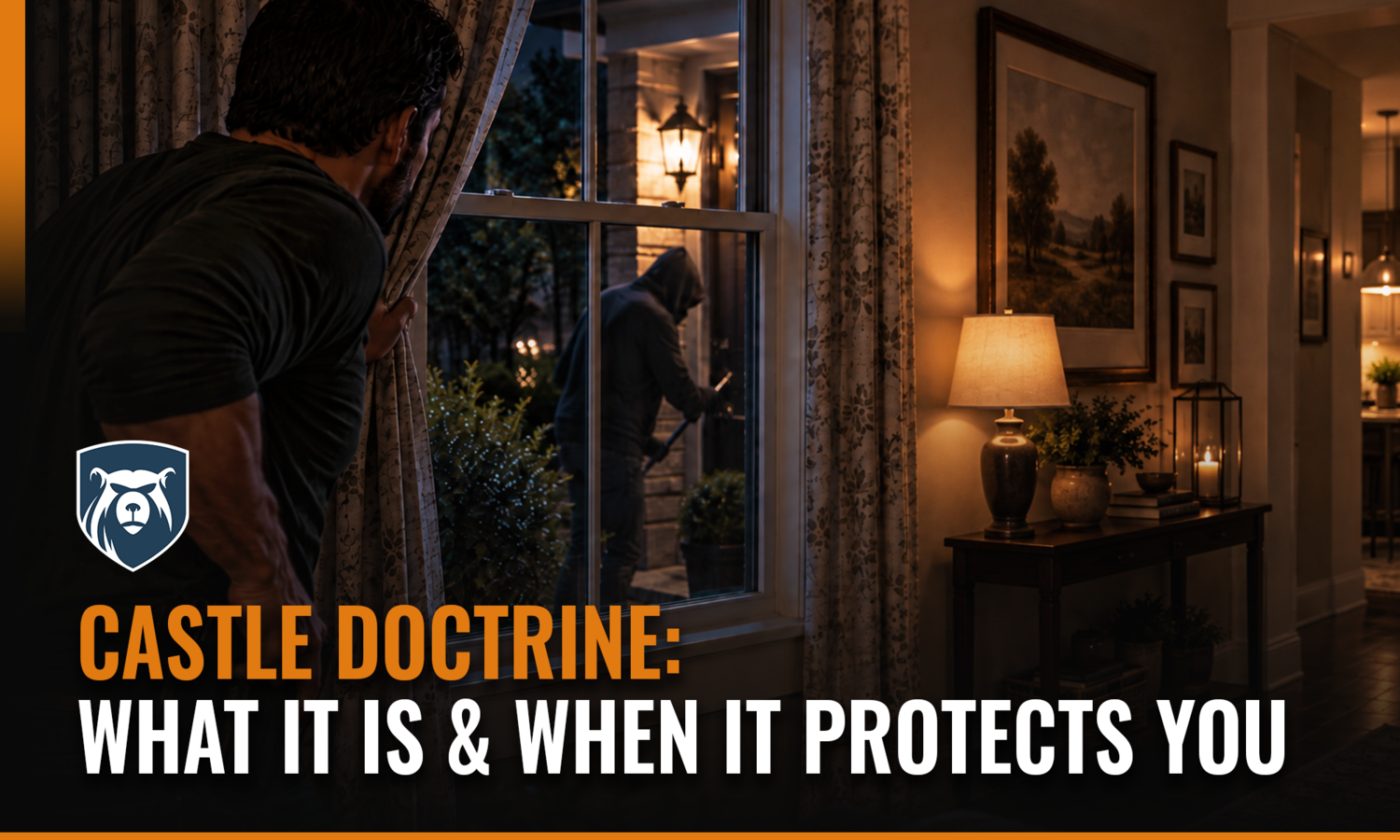
What Is the Castle Doctrine?
Castle doctrine is a legal principle that lets you use force, including deadly force, to defend yourself against an intruder in your home without a legal duty to retreat first. In short, if someone breaks into your house, the law generally doesn't require you to try to run away before you're allowed to defend yourself. Your home is treated as the one place where you're not expected to retreat, because you're already where you have every right to be.
That's the core idea, but how far it extends, what qualifies as your "home," is the nuance every law abiding gun owner needs to understand to keep them from running afoul of the law.
Want more content like this?
Stay connected with the latest news, updates, and special offers. Join our community by signing up for our newsletter today!
Where the Idea Comes From
The phrase traces back to English common law and the old maxim that "a man's house is his castle," a principle articulated by 17th-century jurist Sir Edward Coke, holding that a person's home was their fortress against unlawful intrusion, including intrusion by agents of the state.
That idea crossed the Atlantic and took root early in American law. It made sense in a young country built around the idea that a person's home was their own domain, a place where they shouldn't have to calculate an escape route before defending their family.
Over time, states codified the principle into statute, formalizing what had largely existed as judicial precedent and common understanding into specific, enforceable legal language.
Today, some version of castle doctrine exists in the majority of states, though the exact wording and scope vary considerably from one to the next.
The Four Elements
Most castle doctrine statutes, regardless of the state, hinge on four core elements. To claim the protection, the situation generally has to satisfy all of them:
- Lawful occupancy. You have to be legally present in the dwelling. This protection is built around defending a home you have a legal right to be in, not just any structure you happen to be standing in.
- Unlawful and forcible entry. The intruder has to be entering, or have entered, illegally and by force. Someone with a key, an invited guest, or a person with a legal right to be there doesn't trigger castle doctrine.
- Reasonable belief of danger. You have to reasonably believe the intruder poses a threat of death, serious bodily harm, or in many states, the commission of a violent felony. This is judged by what a reasonable person would believe in the moment, not by hindsight.
- Proportional force. The force used has to be proportional to the threat. Castle doctrine removes the duty to retreat; it doesn't remove the requirement that your response be reasonable given the danger you faced.
What Counts as Your "Castle"
The dwelling itself, your house, apartment, or condo, is always covered. The term “castle" often extends further than the walls of the structure.
Many states extend protection to the curtilage, the immediate area surrounding the home, like a porch, yard, or attached deck. An attached garage is typically treated as part of the dwelling as well, since it's directly connected to the home and functions as an extension of it.
Coverage for apartments generally works the same way it does for a house: your unit is your dwelling, and the same lawful-occupancy and forced-entry requirements apply, though shared spaces like hallways or building lobbies typically fall outside the protection since they aren't exclusively yours.
Vehicles are a different story, and this is one of the areas where state law diverges the most. Some states explicitly extend castle doctrine to an occupied vehicle, treating it much like a home for purposes of the presumption of reasonableness. Others don't extend the doctrine to vehicles at all, leaving any defensive use of force in a car to be evaluated under ordinary self-defense standards instead.
If you're unsure where your state falls on vehicle coverage, it's worth checking your specific state's statute directly, since this is one of the most commonly misunderstood parts of castle doctrine nationally. See our breakdown of castle doctrine states for how this plays out by jurisdiction.
The Presumption of Reasonableness
In many states, castle doctrine does more than just remove the duty to retreat. It also creates a presumption of reasonableness, meaning that if the legal elements are met, an unlawful and forcible entry occurred while you were lawfully present, the law presumes you reasonably feared death or serious harm, without requiring you to prove that fear from scratch.
That matters enormously in practice. Instead of the defender having to affirmatively prove their state of mind was reasonable, the burden shifts to the prosecution to prove it wasn't. This principle doesn't guarantee an outcome, and it doesn't apply if the underlying elements aren't met, but it changes who has to prove what, which is often the difference between a case that goes to trial and one that doesn't.
When Castle Doctrine Does Not Protect You
Castle doctrine has real limits, and prosecutors look closely at whether any of these apply before a self-defense claim gets far.
- You were the aggressor: If you initiated or escalated the confrontation, castle doctrine generally doesn't apply. The protection exists for defending against an intrusion, not for provoking one.
- You weren't lawfully occupying the space: Trespassers and unauthorized occupants don't get the benefit of the doctrine, since the entire framework assumes you had a legal right to be there.
- The force used was excessive: Even a lawful start to a defensive situation can lose protection if the force applied went beyond what the threat actually required.
- For example, if an intruder has been disabled and you reload and continue to fire.
- Force was used against someone fleeing: Once an intruder is retreating and no longer poses an active threat, continued force is much harder to justify under most state laws.
- The other person is a cohabitant: Castle doctrine is built around defending against outside intruders. Most states don't apply its protections to conflicts between people who legally share the home, like roommates, family members, or a spouse.
Castle Doctrine and Civil Liability
Being protected from criminal prosecution under castle doctrine does not automatically protect you from a civil lawsuit over the same incide.
Criminal and civil cases run under different standards of proof, and a lower civil standard means it's entirely possible to be cleared criminally, or never charged at all, and still face a wrongful death or injury lawsuit from the other party or their family. Castle doctrine statutes address criminal liability and, in some states, civil immunity as a separate provision, but the two aren't automatically the same thing, and it depends heavily on how your specific state's law is written.
For a closer look at how the two protections differ, see castle doctrine vs. stand your ground, which covers this distinction along with the broader relationship between the two doctrines.
Given that gap, many people who take home defse seriously look into legal protection like Right To Bear that specifically covers civil defense costs, not just criminal defense, since a civil suit can be financially devastating even when the underlying self-defense claim was fully justified.
You can read more about what that kind of coverage includes on our CCW insurance page.
FAQ
What is the definition of the Castle Doctrine?
The Castle Doctrine is a self-defense legal principle that generally allows people to defend themselves in their home without a duty to retreat. Specific protections vary by state.
How do Castle Doctrine and Stand Your Ground laws differ?
Castle Doctrine generally applies to the home, while Stand Your Ground laws can remove the duty to retreat in other places where a person is lawfully present.
Does Castle Doctrine apply to vehicles or places of work?
In some states, yes. Castle Doctrine protections may extend to occupied vehicles, workplaces, or other locations defined by state law.
How does the duty to retreat differ from Castle Doctrine?
Castle Doctrine generally removes the duty to retreat inside a protected home. A duty to retreat may still apply outside the home unless broader state law provides otherwise.
What are the Castle Doctrine requirements for using deadly force?
Deadly force generally requires a reasonable belief that it is necessary to stop an imminent threat of death or serious bodily harm. Additional requirements vary by state.
What legal rights do homeowners have under Castle Doctrine?
Homeowners may be able to defend themselves without retreating and, in some states, receive a presumption that their fear was reasonable during an unlawful and forcible entry.
What is the history and origin of Castle Doctrine in common law?
Castle Doctrine comes from the common-law principle that a person should not have to retreat from their home before defending themselves against an unlawful threat.
Which states have the strongest Castle Doctrine laws?
There is no single definition of the "strongest" Castle Doctrine law. States differ in where the law applies, whether it creates a presumption of reasonable fear, and whether it provides civil immunity.
Is a guest covered under the Castle Doctrine?
In some states, lawful guests or occupants may receive Castle Doctrine protections. Eligibility depends on the state's definition of a protected dwelling and the circumstances.
How does Castle Doctrine differ from general self-defense laws?
Castle Doctrine provides specific protections for defensive force in a home or other covered location. General self-defense laws determine when the use of force is justified more broadly.
Does Castle Doctrine protect against civil liability?
Some states provide civil immunity when force is legally justified under Castle Doctrine. The scope of that protection varies by state.
When does Castle Doctrine not apply during a break-in?
Castle Doctrine may not apply if the person entering has a legal right to be there, the defender provoked the confrontation, or other statutory requirements are not met. State laws define the specific exceptions.
ONE WRONG MOMENT SHOULDN'T COST YOU EVERYTHING
Carry with confidence. Right To Bear backs you with 24/7 attorney-answered support and full legal defense — no caps, no deductibles. Become a member today.