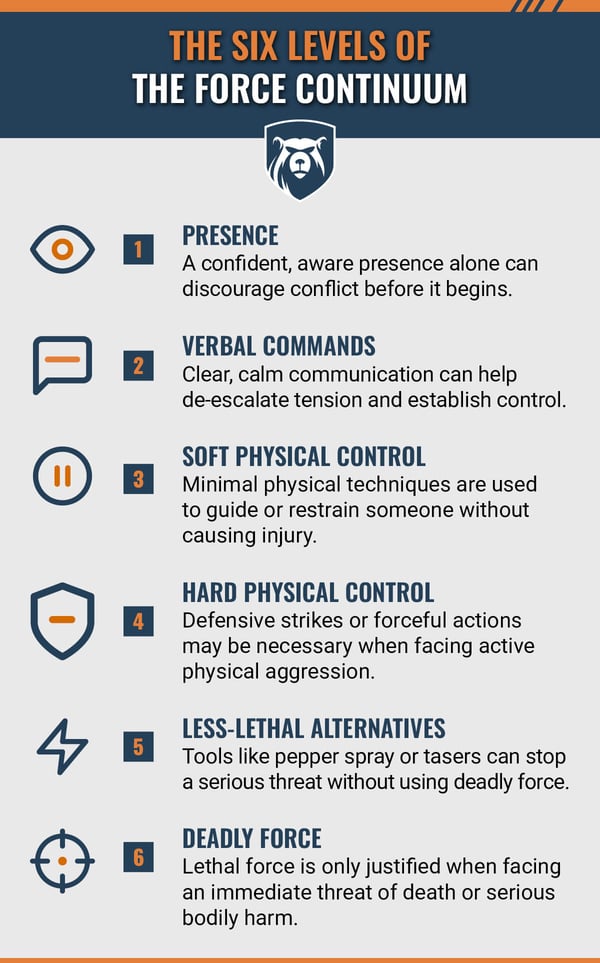
The use of force continuum helps determine whether a response to a threat was reasonable, proportional, and legally justified. It generally progresses through six levels: presence, verbal commands, soft physical control, hard physical control, less-lethal force, and deadly force.
Although the continuum is not itself a law, courts may use similar principles when evaluating whether someone escalated appropriately during a self-defense incident. Understanding this framework is especially important for anyone who carries a firearm or other defensive tool.
When Self-Defense Gets Real: Why the Use of Force Continuum Matters
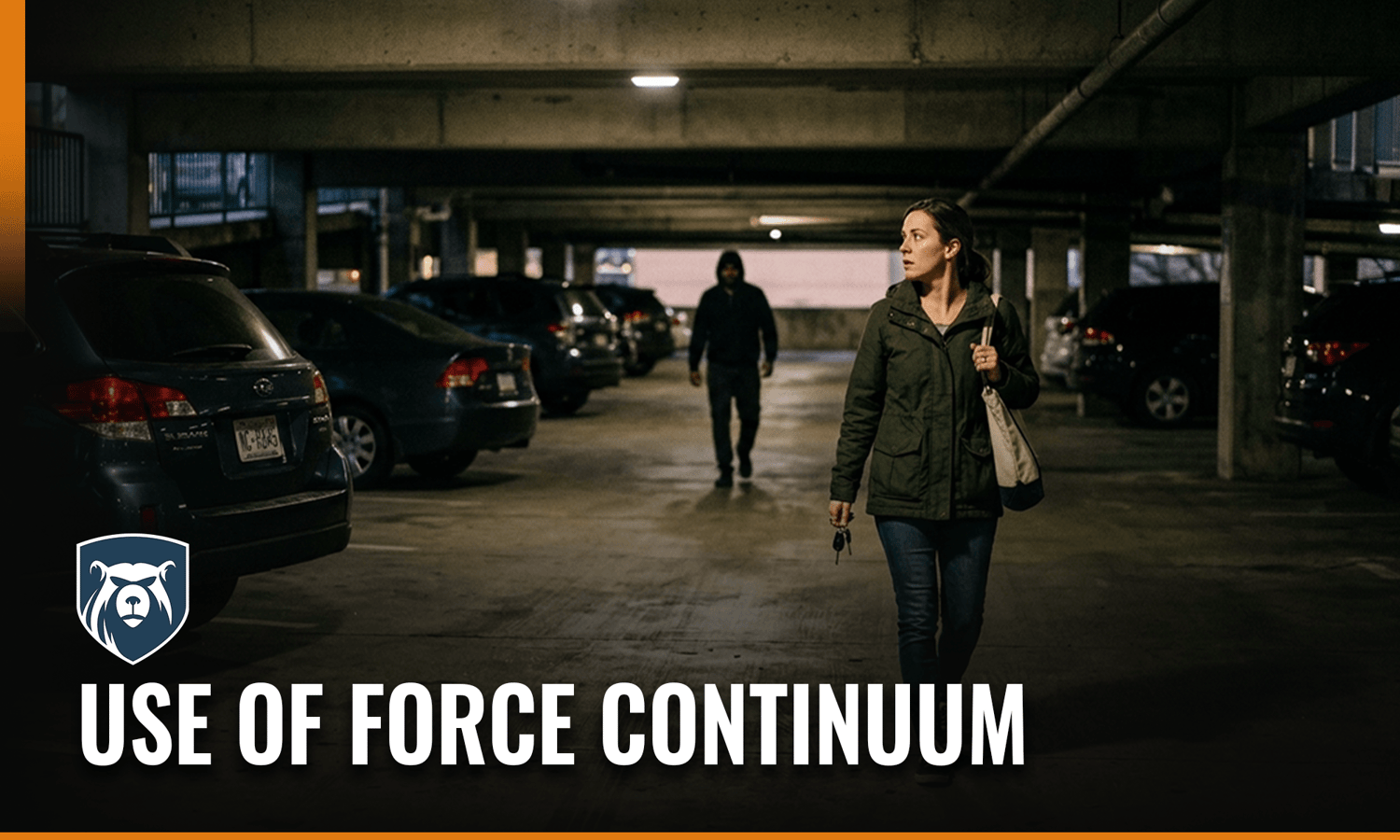
Imagine you’re walking to your car after dark. Someone follows you, shouting aggressively. You stop, ask them to leave you alone. They keep coming. Your hand goes to your concealed carry weapon—but do you draw? Do you run? Do you shout again?
Situations like this happen every day. Split-second decisions can lead to lawsuits, arrests, or worse. That’s where the use of force continuum comes in. It’s not just a police training term. It’s a blueprint for reacting proportionately to danger—and defending your decisions in court if it comes to that.

What Is the Use of Force Continuum?
The use of force continuum is a structured model that outlines escalating levels of force. It helps determine what response is appropriate in a given situation—especially when things get physical. While originally developed for law enforcement, it’s now widely used in civilian training courses, concealed carry classes, and self-defense law education.
The core idea is simple: force should escalate with the threat level. If someone is yelling at you, don’t punch them. If someone is lunging at you with a knife, don’t try to talk them down. Your response should make sense for the situation.
Most use of force models include three main factors:
- Assessment: Are you in danger? What’s the environment? Are others at risk?
- Subject Behavior: Is the person passive, aggressive, assaultive, or presenting a deadly threat?
- Response Options: Based on behavior, what level of force is legally and practically justifiable?
The Six Levels of Force in the Continuum
Understanding the levels makes the continuum easy to apply in real life. The steps aren’t always followed in order, but they provide a foundation for making quick, lawful decisions.
Presence
Your very existence can be a deterrent. Confidence, awareness, and body language can prevent a threat from escalating. Whether you're a police officer or a prepared civilian, a calm, assertive presence can neutralize tension before it starts.
Verbal Commands
Words matter. Clear, concise verbal commands like “Stay back” or “I don’t want trouble” can de-escalate tension. How you say it matters just as much as what you say. Aggressive shouting might inflame the situation. Calm, firm instructions can end it.
Soft Physical Control
If verbal commands fail and the person becomes physically noncompliant—but not violent—soft control techniques are next. This includes joint locks, pressure points, or guiding someone away. Think of restraining someone without causing pain or injury. It’s about regaining control without violence.
Hard Physical Control
This is when you need to use strikes—punches, kicks, elbow hits, maybe a takedown. You only go here when someone is actively resisting or physically attacking you. This level introduces risk—to you and the attacker—and must be justifiable under your state’s laws.
Less-Lethal Alternatives
If the threat is severe but not yet lethal, non-lethal weapons like pepper spray, Tasers, or batons may be your best option. These tools are incredibly useful, but they also require proper use. A Taser in the wrong hands can backfire. Pepper spray is useless if the wind is blowing toward you. Know your tools before you rely on them.
Deadly Force
This is the final option—used when you or someone else is in immediate danger of death or serious bodily harm. Deadly force includes using a firearm or any force that could reasonably cause death. It must be proportional, necessary, and legally defensible. In many states, you'll also have to show that you didn’t provoke the incident and that your response was immediate and unavoidable.
Does the Continuum Apply to Civilians?
Yes—and it should. Civilians may not be required by law to follow the use of force continuum step-by-step, but using it can keep you within the bounds of reasonableness. That matters when a prosecutor or jury reviews your case. If you went straight to hard physical force or deadly force without any attempt to de-escalate, you may be seen as reckless or unjustified. Understanding this framework helps you make better decisions under stress and explain them afterward if needed.
What Is the National Use of Force Framework?
The National Use of Force Framework (NUFF) is a standardized guide often used in police training across North America. It reinforces that every use of force decision must be based on situational assessment and reasonable judgment. For civilians, it reinforces the idea that:
- Force should be the last resort
- You should continuously assess the situation
- Repositioning or retreating (where legal) is often safer than confrontation
The NUFF emphasizes that legal outcomes depend not just on what you did, but how and why you did it.
Limitations of the Use of Force Continuum
No model is perfect. The continuum doesn’t account for every situation. Sometimes you’re dealing with multiple attackers. Sometimes the environment—tight spaces, low light, loud noise—interferes with communication or recognition. Sometimes people skip straight from verbal abuse to violence with zero warning. That’s real life.
The continuum also assumes a clear line between subject behavior levels. But most people don’t fit neatly into categories. Someone might seem passive but escalate quickly. Someone may be assaultive but confused or mentally ill. You have to make decisions in seconds with limited information. That’s why the law cares about reasonableness, not perfection
How Courts Use the Use of Force Continuum
Courts look at your use of force through a lens of reasonableness. The continuum becomes a reference point for analyzing whether your actions matched the situation.
Questions often asked in court include:
- Did you assess the threat accurately?
- Did you attempt to de-escalate?
- Was your force proportional to the behavior you encountered?
- Did you skip intermediate steps without cause?
If your use of force looks like a wild overreaction, prosecutors and juries will notice. But if you can clearly explain your decisions using the continuum’s logic, you stand a better chance of being seen as reasonable—and staying out of jail.
How to Apply the Continuum in Real Life
- Stay aware of your environment. The earlier you detect a threat, the more time you have to act appropriately.
- De-escalate when possible. Words are free. Use them before you use force.
- Train with your tools. Don’t carry pepper spray or a firearm you’ve never practiced with.
- Know your local laws. Some states expect you to retreat. Others don’t. Ignorance is not a defense.
- Use force only when necessary. And only as much as necessary.
Common Mistakes People Make with Use of Force
- Going straight to fists or weapons without assessing or trying to de-escalate
- Escalating verbal conflicts into physical ones
- Using deadly force when there was no clear threat of serious injury or death
- Misjudging the behavior of the subject—assuming intent without verifying it
- Carrying weapons they don’t know how to use properly
Use of Force Continuum FAQ
Is the use of force continuum the same in every state?
No. States and law enforcement agencies vary in how they apply the model. Some include specific steps and terminology, while others take a broader approach.
Can civilians use the use of force continuum?
Absolutely. While it's not a legal requirement, it's a smart guideline for making legally sound self-defense decisions.
What happens if I use too much force?
You could face criminal charges, civil lawsuits, or both. Excessive force can nullify your self-defense claim, even if you were initially justified.
Is verbal de-escalation always required?
No, but it's encouraged when possible. If it’s safe to use verbal commands first, do so. If not, and the threat is immediate, escalation may be justified.
Are non-lethal weapons safer than deadly force?
Yes—but only if they’re used appropriately. Misuse can still cause serious injury or legal consequences.
What is considered deadly force?
Force likely to cause death or serious injury—typically firearms, knives, or blunt force to vital areas. It must be justified by an imminent, serious threat.
What Is Lexipol and How Does It Influence Use of Force Policy?
Lexipol is a policy management platform used by many law enforcement agencies to standardize procedures, including those related to the use of force. It offers legally vetted policy templates and daily training bulletins to help departments stay compliant with federal and state laws. While Lexipol isn’t law itself, its widespread adoption means it heavily influences how agencies interpret and implement use of force guidelines. Civilians should be aware that if an agency uses Lexipol, its officers may follow a specific force continuum model derived from those policies.
How Does Tactical Gear Affect Use of Force Decisions?
Gear plays a more influential role in use of force decisions than many people realize. Equipment like body armor, Tasers, expandable batons, and duty belts are not just accessories—they shape what options are available to a responder. The presence or absence of non-lethal alternatives can influence whether an officer or civilian escalates to higher levels of force. For civilians, understanding what gear is legally permissible and how to use it effectively is critical in ensuring that responses remain proportionate and defensible.
What Role Do Officers Play in Determining Reasonable Force?
Officers are expected to be professionally trained in using force within the bounds of law, policy, and situational context. But “reasonable force” is still a judgment call—often made in seconds. Officers must consider whether the threat is imminent, whether lesser options have been exhausted or are unavailable, and whether their actions will stand up under legal scrutiny. Body cams, witness accounts, and department policy often shape the aftermath. Civilians who understand how officers are trained (and judged) can better align their own self-defense decisions with legal expectations.
How Does the Concept of Justice Apply to Use of Force Cases?
Justice in use of force cases is often less about immediate outcomes and more about long-term accountability. Courts must weigh the legality and proportionality of the force used, while also considering intent, perception, and context. A just outcome isn’t always a clear one. What feels like a righteous act of self-defense to one person might be seen as excessive force by another. This is why understanding the continuum, documenting incidents, and acting within established legal frameworks is crucial. Justice is served best when actions are both lawful and ethical.
How Does Police Training Impact Use of Force Outcomes?
Police agencies train extensively in the use of force continuum, but training depth varies widely across jurisdictions. Departments with well-funded training programs emphasize de-escalation, scenario-based judgment, and decision-making under stress. In contrast, underfunded or outdated departments may rely more on instinct or policy than on practice. This impacts not only how force is used but also how it's perceived by the public. Civilians who understand police training methods are better equipped to make lawful self-defense decisions—and to interpret law enforcement behavior during high-pressure encounters.
Final Thoughts: The Force Continuum Isn’t Just for Cops
If you carry a weapon or ever find yourself in a potentially dangerous situation, understanding the use of force continuum isn’t optional—it’s essential. It’s how you avoid overreacting, how you make smart decisions under pressure, and how you explain those decisions if you’re ever standing in front of a judge or jury.
Using force responsibly isn’t just about stopping a threat. It’s about making sure you’re still seen as the good guy afterward. That starts with knowing the levels of force, training for the worst, and staying calm in the middle of chaos. Because when it comes to self-defense, the most dangerous weapon is ignorance.