Key Takeaways: Understanding Duty to Retreat Laws
- Duty to retreat laws require individuals to avoid using force—especially deadly force—if it’s possible to escape the threat safely
- These laws are the opposite of stand your ground, which lets you defend yourself without backing down, even in public spaces
- About a dozen states follow some version of duty to retreat, often with exceptions for the home (Castle Doctrine)
- You don’t have to retreat if it puts you in more danger—reasonable judgment and the totality of the circumstances matter
- Knowing your state’s law is essential if you carry a firearm or plan to use force in self-defense
You’re Being Followed: Now What?
Imagine walking to your car in an empty parking lot at night. You hear footsteps behind you. You speed up. The steps get closer. You turn around—someone’s there, saying nothing, just watching.
See also: What Is Jugging?
Now ask yourself: do you run? Do you confront? Do you draw your weapon? If you live in a duty to retreat state, the answer might surprise you.
Unlike stand your ground states, where you can defend yourself without retreating, duty to retreat laws expect you to avoid violence if escape is safely possible. That expectation can affect not just your decision in the moment—but whether or not you face criminal charges afterward.
If you carry a gun responsibly, train in self-defense, or even just want to know your rights, understanding the duty to retreat laws isn’t optional. It’s the difference between justified self-defense and criminal liability.
What Are Duty to Retreat Laws?
A duty to retreat law requires you to make an effort to escape a potentially violent situation before using force—especially deadly force—unless doing so would put you at greater risk.
These laws emphasize de-escalation over confrontation. The legal system in these states assumes that if you had a safe path to avoid using force, you were obligated to take it.
The idea is rooted in centuries-old legal tradition, prioritizing preservation of life—on both sides of the altercation.
But this isn’t about pacifism. It’s about accountability. It’s about proving in court that you truly had no better option.
How Does Duty to Retreat Work?
Duty to retreat laws don’t demand that you run away in every situation. Instead, they ask one question: Could a reasonable person have safely walked away instead of using force?
Let’s break it down.
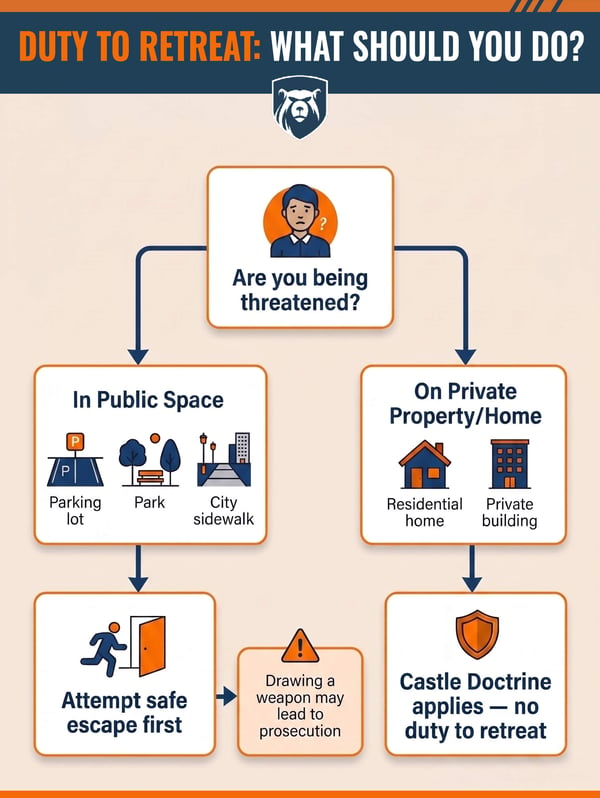
Public Spaces
If you’re in a parking lot, park, or sidewalk in a duty to retreat state and someone threatens you, the law expects you to attempt escape—if it’s safe.
If you draw a gun instead of walking away, you may be prosecuted, even if you believed you were in danger.
Private Property
Most states make an exception for private spaces, especially your home. This is where Castle Doctrine comes into play—removing the obligation to retreat if you’re in your own dwelling or sometimes even your workplace.
When It Doesn’t Apply
If the attacker blocks your exit, if running would expose you to greater danger, or if you're defending a third party, duty to retreat typically doesn't apply.
The law doesn't expect heroics—but it does expect reasoned judgment.
Duty to Retreat vs. Stand Your Ground: What’s the Difference?
If you're wondering whether your state expects you to retreat or allows you to hold your ground, here's a quick comparison:
|
Feature |
Duty to Retreat |
Stand Your Ground |
|
Obligation to escape? |
Yes, if safe |
No |
|
Applies to public spaces? |
Yes |
Yes |
|
Castle Doctrine exception? |
Usually |
Usually |
|
Burden of proof? |
Often on defendant |
Varies |
|
Legal philosophy |
Prioritize de-escalation |
Prioritize immediate defense |
The key distinction is this: duty to retreat requires avoidance, while stand your ground allows confrontation if you’re lawfully present and reasonably believe force is necessary.

States That Have Duty to Retreat Laws
As of now, the following states enforce some version of a duty to retreat, especially in public spaces:
- Connecticut: Retreat required when safe
- Delaware: Emphasizes peaceful avoidance
- Hawaii: Must retreat unless danger is immediate
- Maine: Avoid force if feasible
- Maryland: Must retreat in public before using deadly force
- Massachusetts: Reasonable effort to escape required
- Minnesota: Retreat unless it increases danger
- Nebraska: No retreat required at home or work, but elsewhere yes
- New Jersey: Retreat required unless clearly unsafe
- New York: Must retreat if it can be done in complete safety
- Rhode Island: Encourages avoidance where possible
Some of these states also extend Castle Doctrine protections to private property, vehicles, or businesses—but not always. Read your local laws.
When Is Retreat Not Required?
Duty to retreat laws do not apply when:
- You're in your home and Castle Doctrine applies
- Escape routes are blocked or unsafe
- You’re protecting a child or another third party
- The attacker is using deadly force and retreat would expose you to harm
- The law specifically allows for immediate use of force due to imminent threat
These exceptions are critical. Self-defense laws are rarely black and white—and your actions will be judged based on context, not just technicalities.
The Pros of Duty to Retreat Laws
Encourages De-escalation
These laws promote peaceful resolution and force as a last resort—not the first option.
Strengthens Legal Defense
If you can demonstrate that you tried to avoid conflict before using force, it strengthens your case and credibility in court.
Saves Lives
Let’s be honest—sometimes walking away is safer for everyone involved. The fewer bullets flying, the better. Not sure the last line is needed iethis linenot
The Cons of Duty to Retreat Laws
Creates Legal Gray Areas
What exactly is a “safe opportunity to retreat”? Prosecutors and juries may not agree on what was “reasonable.”
Limits Self-Defense Rights
In fast-moving situations, requiring retreat can delay action and put the defender at more risk—especially if the attacker is armed.
Can Be Exploited by Aggressors
Some critics argue that these laws create hesitation that emboldens violent individuals who believe their targets are legally required to back off.
How to Navigate Duty to Retreat Laws (Without Ending Up in Court)
1. Know Your State Laws
This sounds obvious, but many gun owners couldn’t explain whether they live in a duty to retreat state or
not. That’s dangerous—for you and others. Look up your state’s criminal code, or consult with a self-defense attorney. Don’t assume.
2. Train for De-escalation
Most violent encounters don’t start with fists—they start with words. Learn how to calm situations. Use verbal boundaries. Create space. De-escalation isn't weakness—it's tactical maturity.
3. Understand Proportional Force
If someone shoves you, pulling a firearm is probably going to land you in jail. Know when non-lethal or no force is the right call.
4. Practice Scenario-Based Training
If you’re carrying a weapon but have never run realistic drills, you’re not ready. Learn how to make decisions under stress, including how and when to retreat.
Frequently Asked Questions About Duty to Retreat Laws
Does the duty to retreat laws apply in all states?
No. Only about a dozen states have duty to retreat laws. Most others have stand-your-ground laws or hybrid models. Know where you stand—literally.
What happens if I cannot safely retreat?
If retreating would put you in more danger, the law generally allows you to defend yourself. Courts focus on what a “reasonable person” would do.
Do these laws apply in private property disputes?
Usually no. In most states, Castle Doctrine covers your home, and sometimes your vehicle or business. You aren’t required to flee your own kitchen.
How do courts evaluate whether I should’ve retreated?
They’ll assess the threat level, physical layout, timing, and your ability to escape. If there was an obvious exit, they may question your use of force.
Can retreating strengthen my legal defense?
Yes. If you try to leave and still have to defend yourself, you’re showing restraint. That matters in court.
Are there legal protections if I follow the duty to retreat?
Yes. In many cases, retreating can prevent charges altogether—or create a much stronger self-defense case if you still end up using force.
Final Thoughts: Retreat Isn’t Surrender—It’s Strategy
Duty to retreat laws get a bad rap in gun circles. They’re seen as soft, unrealistic, even dangerous. But when understood correctly, they’re just another tool in the self-defense toolkit.
Knowing when to walk away can save your life—or at least save you from spending it in court.
That doesn’t mean you should hesitate when you’re truly in danger. It means your decisions should be backed by awareness, training, and a clear understanding of the law.
Because when the time comes, it’s not about looking tough—it’s about making the right move.