

"My department has me covered."
It is one of the most common assumptions in law enforcement, and one of the most dangerous to leave unquestioned. Union representation and agency-assigned counsel are real protections, but they were built around the institution's interests, not necessarily yours, and they do not extend to every situation an officer might face.
After a critical incident, the gaps in that coverage tend to appear quickly. Criminal exposure, civil liability, and administrative review all operate under different rules, and department support in one track does not guarantee coverage in the other two. Understanding the difference before you need it can protect your career and your finances.
What Departments Typically Cover
Most departments and unions provide a meaningful baseline of protection, and it is worth understanding clearly what that includes.
Administrative representation covers Internal Affairs interviews, policy compliance reviews, and disciplinary hearings. This is generally where department and union support is strongest, since these proceedings directly involve the agency's own internal processes.
Agency-assigned counsel provides legal representation, but that representation is selected by the department and its focus is institutional liability. The attorney's job is to protect the agency's interests, and in many cases those interests align closely with the officer's. In many cases, but not always.
Qualified immunity defense can apply in certain federal civil claims, but it is not absolute protection. It is a legal doctrine that gets litigated, not a guarantee that shields an officer from civil exposure entirely.
Many officers assume this baseline equals full law enforcement liability insurance. It does not.
Explore: Right To Bear LEO Legal Protection
What Departments Often Do Not Cover
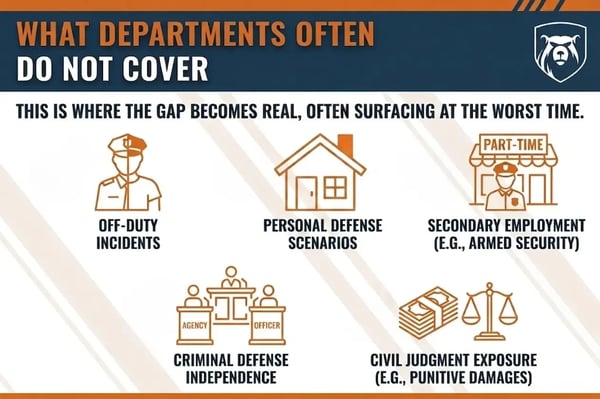
This is where the gap becomes real, and where it tends to surface at the worst possible time.
Off-duty incidents are frequently outside the scope of department coverage entirely. A personal defense scenario while off duty, a secondary employment situation, or armed security work on the side can all fall into a coverage gap that an officer does not discover until they need it. This is where the value of the Right To Bear LEO Legal Protection Plan shines, giving you experienced legal protection whether you are on or off duty.
Criminal defense independence is a structural problem. When a prosecutor is investigating an officer's actions, the department cannot fully represent both the agency and the individual officer at the same time. Their interests can diverge in ways that matter enormously to the outcome of a criminal case.
Civil judgment exposure is another area where department support has limits. Punitive damages in particular can create personal financial exposure for an officer that department or union coverage does not address.
Most departments do not provide standalone law enforcement liability insurance for off-duty use-of-force incidents. That single gap covers a significant portion of the situations where officers most need protection.
See also: Off-Duty Officer Legal Risk: When the Badge Doesn't Protect You
Conflict-of-Interest Scenarios
There are specific situations where the agency's interests and the officer's interests can diverge in ways that affect the quality of representation an officer receives.
When agency interests diverge from the officer's, typically in cases involving alleged policy violations, high public pressure, or political sensitivity, assigned counsel may prioritize the agency's defense over the individual officer's. The officer can become a secondary concern in their own case.
When agencies distance themselves is the scenario officers fear most, and it does happen. High-profile police shootings, intense media scrutiny, and civil rights litigation can all create circumstances where an agency's public posture shifts away from the officer involved, even when that officer followed policy and training.
Criminal vs Civil Defense: Critical Differences
These three tracks operate under entirely different rules, and department support in one does not translate to the others.
Criminal prosecution is the state against the officer, decided under a beyond reasonable doubt standard, with the officer's personal liberty at stake.
Civil lawsuit is the plaintiff against the officer and often the agency, decided under a preponderance of evidence standard, with financial damages as the outcome.
Administrative discipline focuses on policy compliance, with employment consequences as the result.
Department support in one track does not guarantee coverage in all three. An officer can have strong administrative representation and still face significant gaps in criminal defense independence or civil exposure.
Off-Duty Legal Risk Gaps
Off-duty situations create some of the widest coverage gaps for officers, often in scenarios that feel similar to on-duty situations but are treated very differently by department policy.
Personal carry incidents involving use of force outside the scope of department duties typically fall outside agency coverage entirely.
Security and secondary employment situations, including armed security assignments and private event protection work, often exist in a gray area where department coverage simply does not apply.
Jurisdictional complications can arise when an officer is acting outside their primary agency's area, raising questions about which agency, if any, has any obligation toward the officer's defense.
Many officers only discover the limits of their police insurance after an off-duty incident has already occurred, which is precisely the wrong time to find out.
See Also: What Happens After an Officer-Involved Shooting?
Attorney Selection Restrictions
When a department provides counsel, that attorney is assigned, not chosen. The officer typically has limited input into who represents them, even though that attorney's strategy will significantly affect the outcome of the case.
Independent legal strategy means the ability to retain private counsel and receive early advisory guidance from an attorney whose only job is representing the officer's individual interests. This matters enormously because of strategic timing. First statements, made in the hours after an incident, often determine the trajectory of everything that follows. An officer with independent counsel available immediately can get guidance before those statements are made, not after.
With Right To Bear, your membership gives you the flexibility to choose one of our experienced gun law attorneys or bring your own and still have access to criminal and civil legal protection.
Financial Exposure, Even with Union Support
Union representation provides real value, but it is not the same as comprehensive law enforcement insurance coverage, and the financial exposure that remains can be significant.
Criminal defense costs typically start at $30,000 and climb from there depending on case complexity.
Civil litigation expenses escalate further with extended timelines and expert witness costs. And even where union or department coverage applies, it often comes with coverage caps, reimbursement models rather than direct payment, and approval requirements that can slow down or limit the support an officer actually receives.
Side-by-Side Comparison: Department vs Private Legal Protection
|
Feature |
Department / Union Coverage |
Independent Private Legal Protection |
|
Attorney Selection |
Assigned by agency |
Independent choice |
|
Criminal Defense |
Limited / Conditional |
Covered |
|
Civil Defense |
Often shared with agency |
Covered |
|
Off-Duty Incidents |
Frequently excluded |
Covered |
|
Administrative Hearings |
Covered |
Covered |
|
Immediate 24/7 Hotline |
Rare |
Yes |
|
Conflict of Interest Risk |
Possible |
Independent representation |
|
Coverage Caps |
May apply |
Structured protection |
Why Independent Legal Protection Matters
Independent legal protection with Right To Bear is not a replacement for what your department or union provides. It is what fills the gaps.
Control over your defense means strategy autonomy and representation that puts you first, not the institution. If you are ever investigated, you can choose your own attorney or utilize our provided gun law lawyer for both the criminal and civil proceedings, including any appeals, with 100% of those attorney fees covered under a covered incident.
Protection on and off duty closes the employment-status gap that leaves so many officers exposed during personal incidents, security work, or secondary employment. A negligent discharge while cleaning your personal firearm at home, an incident during an off-duty security job, or a personal carry situation outside your jurisdiction are all scenarios where department coverage tends to disappear and independent protection does not.
Immediate access to a 24/7/365 attorney hotline means early guidance before statements are made, regardless of whether the incident happened on or off the clock. That first call matters just as much for an off-duty officer as it does for one involved in an OIS.
Beyond the core legal coverage, membership also includes practical protections built for the realities officers face. If your firearm is seized as part of an investigation, firearm replacement coverage helps get you back to operational readiness. If you are arrested, bail bond benefits provide funds up to $100,000 so you are not sitting in custody while your case moves forward. And if the case requires a ballistics expert, use-of-force specialist, or medical professional to support your defense, expert witness coverage extends up to $10,000 toward that cost.
Private legal protection does not replace department support. The two work together, covering the areas where institutional representation was never designed to reach.
Protect Your Career Before You Need It
Right To Bear LEO Legal Protection includes a 24/7/365 hotline answered by real attorneys, criminal and civil legal fee coverage, administrative investigation support, off-duty incident protection, and emotional support resources. Coverage starts at $220 per year.
Department coverage was built around the institution, covering the gaps that need covering and offering peace of mind to our uniformed peacekeepers. Secure independent legal protection that is built around you.
Frequently Asked Questions
Does my department provide law enforcement liability insurance?
Departments typically provide administrative representation and agency-assigned counsel focused on institutional liability, along with qualified immunity defense where applicable. This is not the same as comprehensive law enforcement liability insurance, and significant gaps remain, particularly for off-duty incidents and independent criminal defense.
What is the difference between union representation and private legal defense?
Union representation is assigned by the department and focused on institutional interests, with limited officer input on attorney selection. Private legal defense is independently chosen, focused exclusively on the officer's interests, and includes immediate 24/7 access regardless of duty status.
Does police insurance cover off-duty incidents?
Frequently not. Off-duty personal defense scenarios, secondary employment, and security work often fall entirely outside department coverage, leaving officers without representation in exactly these situations.
Can I choose my own attorney after a use-of-force incident?
With department-assigned counsel, generally no, the attorney is selected by the agency. Independent private legal protection allows officers to retain their own counsel and receive early guidance before statements are made.
Is private legal protection worth it if I already have union coverage?
Yes. Private legal protection is designed to supplement union coverage by filling the gaps in off-duty protection, independent criminal defense, and immediate attorney access that department and union coverage typically do not address.
Membership starts at only $19 month or $185/year. You don’t need to max out your credit card to get a premium service that includes an experienced attorney and 100% attorney fees for criminal defense and civil defense.