How to Get a Concealed Carry Permit: CCW Permit Process in 2026

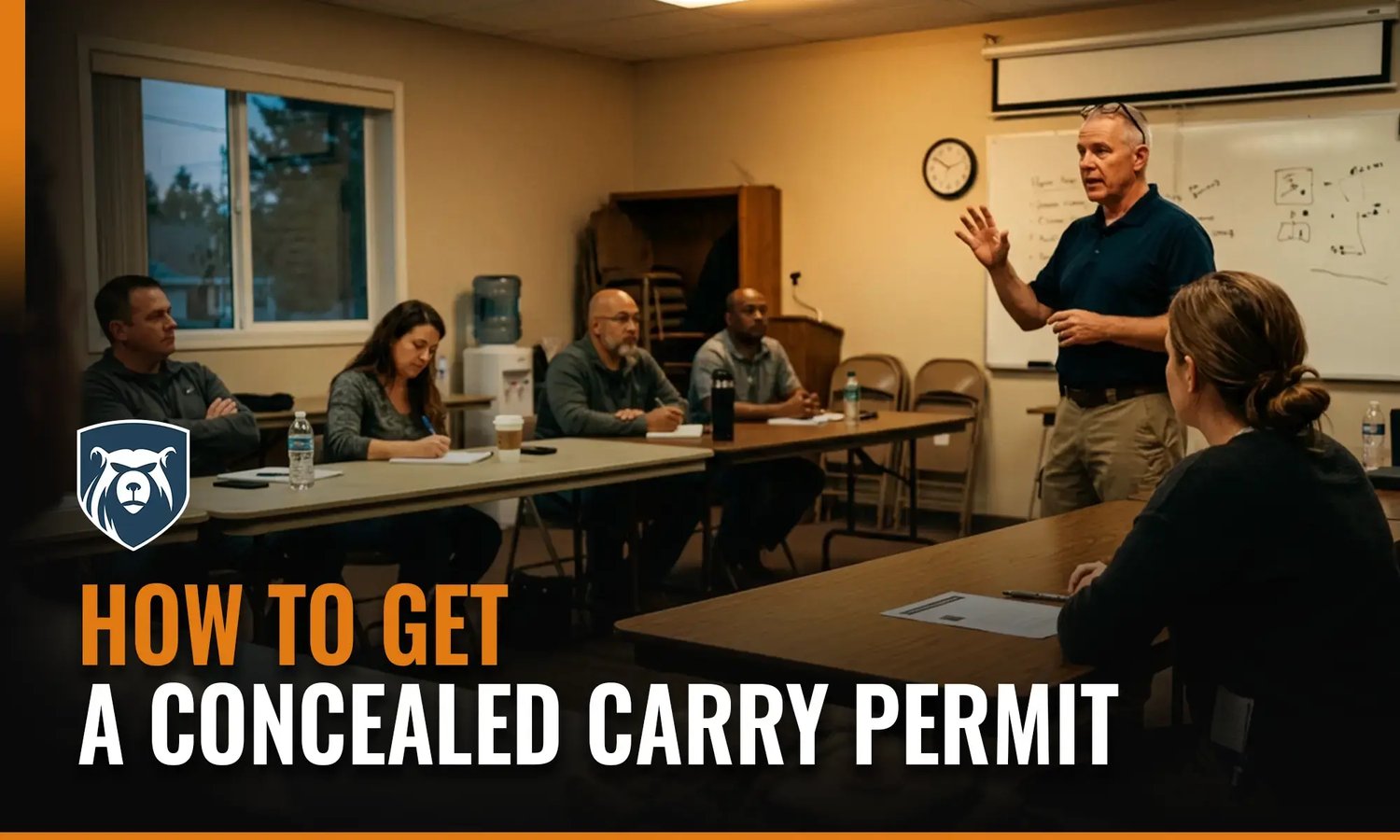
A concealed carry permit — often called a CCW permit — is issued by a state, not by the federal government. That one fact drives everything else. The steps are broadly the same across the country, but the age, the training, the fee, and the wait are all set where you live.
This guide covers the national process: what the permit is, whether your state requires one, who qualifies, the six steps to apply, what it costs, how long it takes, and what happens after the permit is in your hand.
Two things worth knowing up front. Most states no longer require a permit to carry concealed — and plenty of people in those states get one anyway, for reasons worth understanding. And no state issues a valid permit entirely online, whatever a website may tell you.
Want more content like this?
Stay connected with the latest news, updates, and special offers. Join our community by signing up for our newsletter today!
What Is a Concealed Carry Permit?
A concealed carry permit is a state-issued license that authorizes the holder to carry a concealed handgun in public, subject to that state's rules on where and how. It is issued by a state agency, a county sheriff, or in a few states a court, after a background check and, in most states, a training requirement.
States call it different things, and the names cause a lot of confusion. You will see CCW permit, CCW license, concealed carry license, CHL (concealed handgun license), CPL (concealed pistol license), LTC (license to carry), CCDW (concealed carry of a deadly weapon), pistol permit, or gun permit. Different labels, same credential.
One distinction that matters: the permit is the credential, and concealed carry is the act. This page is about how you get and keep the credential.
It is also not a purchase permit. Some states require a separate license to buy a handgun, and a few use one document for both.
Do You Actually Need a Concealed Carry Permit?
It depends on your state — and "no" is not the same answer as "don't bother."
There are three basic situations:
- Permitless carry states. Twenty-nine states let eligible adults carry a concealed handgun without a permit. These states still issue permits to anyone who wants one.
- Permit-required states with objective standards. Most permit-required states must issue a license to any applicant who meets the written requirements — age, training, background, fees.
- Permit-required states that apply added scrutiny. California, Hawaii, Maryland, Massachusetts, New Jersey, and New York rewrote their laws after the Supreme Court's 2022 Bruen decision. They no longer require you to prove a special need, but several kept or added suitability and character standards, longer training, in-person interviews, or reference requirements. Connecticut, Delaware, Indiana, New Jersey, and Rhode Island also apply some form of suitability or good-character test.
Here is why permit holders in permitless states keep their permits:
- Travel. Permitless carry generally covers you at home, not on the road. Reciprocity runs on the credential.
- Buying a handgun. ATF maintains a chart of state permits that qualify as an alternative to the federal NICS check at a licensed dealer. Where a permit qualifies, the dealer may accept it in place of running the check — though no dealer is required to.
- Where you can carry. In some states, holding a permit is what makes carry lawful in locations that are otherwise off-limits.
- The traffic stop. Where an officer can run your permit status, a valid permit is a clear answer to a question they are going to ask.
Concealed Carry Permit Requirements: Do You Qualify?
Start with the part that is identical in all 50 states. Under federal law, 18 U.S.C. § 922(g), you cannot lawfully possess a firearm at all if you:
- Have a conviction for a crime punishable by more than one year in prison
- Are a fugitive from justice
- Are an unlawful user of, or addicted to, a controlled substance
- Have been adjudicated as mentally defective or committed to a mental institution
- Are unlawfully in the United States
- Were discharged from the Armed Forces under dishonorable conditions
- Have renounced your U.S. citizenship
- Are subject to a qualifying domestic violence restraining order
- Have a misdemeanor conviction for domestic violence
No state permit overrides that list. On top of it, each state adds its own layer:
- Age. Twenty-one is the standard, but some states now issue below it. Utah has a provisional permit for ages 18 to 20, Wyoming lowered its permit age to 18 effective July 1, 2026, Kentucky created a provisional license for 18- to 20-year-olds in 2026, and Texas DPS no longer denies applicants solely for being 18 to 20 after a federal court ruling. New York and Maryland carve out exceptions for military members.
- Residency. Some states issue only to residents. Others, including Utah, Arizona, and Florida, issue non-resident permits.
- Training. Requirements run from none, to an online class, to 16 hours plus live fire.
- Fingerprints and background investigation. Standard in most permit states.
- Mental health adjudications, protective orders, and lookback windows on DUI and certain misdemeanors.
A word on marijuana. Marijuana remains a federally controlled substance regardless of state law, and ATF's published position has been that a current user is federally prohibited. In June 2026, the Supreme Court decided United States v. Hemani and held that prosecuting that particular defendant under the unlawful-user provision was inconsistent with the Second Amendment. The Court called the ruling narrow and left the statute standing. ATF has not publicly revised its guidance, and Form 4473 still asks the question. This is unsettled law — talk to an attorney rather than rely on a headline.
How to Get a Concealed Carry Permit: The 6-Step Process
1. Confirm who issues permits in your state
It might be the state police, the department of public safety, the attorney general's office, a county sheriff, or a court. In some states it varies by county, so the office two counties over may run a different schedule and charge a different local fee. Start at the agency's own website, not a third-party site.
2. Complete the required training
Requirements range from a 90-minute online class to a 16-hour course with live fire. Two things to check before you pay: that the course meets your state's content requirements, and that the instructor is approved by your state. A generic online safety certificate does not satisfy most states. The most common expensive mistake is buying the wrong class.
3. Gather your documents
Typically proof of residency, a government photo ID, your training certificate, and passport-style photos. Some states want more. Delaware requires five character references and a published newspaper notice. Utah requires non-residents to submit their home-state permit if that state recognizes Utah's.
4. Get fingerprinted
Most states require electronic fingerprints through a contracted vendor. Book early. Rejected prints are one of the most common causes of delay, and a rejection means going back and doing it again.
5. Submit the application and fee
Some states run an online portal. Others require an in-person appointment or a mailed packet. Incomplete applications get returned — Arizona's application form says so in capital letters — and in most states the processing clock does not start until the agency has a complete packet.
6. Wait for the background check and decision
The agency runs your background check and issues or denies. What that wait actually looks like is the next section.
How Much Does a Concealed Carry Permit Cost?
Application fees run from nothing to a few hundred dollars, and the application fee is rarely the biggest number. Here is what several states charge, from their own agencies:
|
State |
Application fee |
Renewal |
Permit term |
|---|---|---|---|
|
Indiana |
$0 |
$0 |
5 years or lifetime |
|
New Hampshire |
$10 resident / $100 non-resident |
Same |
5 years |
|
Pennsylvania |
$20 |
$20 |
5 years |
|
Texas |
$40 |
$40 |
4 years initial / 5 years renewal |
|
Arizona |
$60 |
$43 |
5 years |
|
Florida |
$97 (includes $42 fingerprint fee) |
$45 |
7 years |
|
Illinois |
$150 resident / $300 non-resident |
Same |
5 years |
|
California |
Set locally; varies widely by county |
Varies |
2 years |
Budget for the whole package, not the line item:
- Application fee — see above
- Training course — usually the largest single cost. It is set by private instructors, and no government agency publishes a standard price, so call two or three providers near you.
- Fingerprinting — often billed separately. Indiana charges $12.95; Utah charges $20 at its Bureau of Criminal Identification; Florida builds $42 into the application fee.
- Passport photos and renewal every few years
Fees change, sometimes on short notice. Utah's resident permit fee moves from $52 to $55 on October 1, 2026. Confirm the current amount with the issuing agency before you write the check.
How Long Does It Take to Get a Concealed Carry Permit?
Most states set a legal deadline of 45 to 90 days for the agency to approve or deny — and that clock usually starts when the agency has a complete application, not the day you dropped it off.
That gap is where the frustration lives. Texas has 60 days for an original license and 45 for a renewal, but gets another 180 if it has to request more information from you. Illinois has 90 days, plus 30 more if you skipped electronic fingerprints, and the clock pauses entirely if a law enforcement agency objects. Arizona's statute allows 60 days plus 15 working days, and DPS asks applicants to allow 75. Florida has 90 days, extendable by 45 when a charge shows no final disposition.
What actually causes delays:
- Fingerprints rejected for quality
- An incomplete packet — the most common cause, and the most preventable
- Court records the agency has to chase, especially old or out-of-state cases
- A law enforcement objection
- County or agency backlog
If your state's deadline passes, start with the agency's status tool — Texas, Florida, Illinois, and Arizona all publish one. Two states put teeth in the deadline. In Texas, failure to act more than 30 days past the required date legally counts as a denial, which opens a hearing process. In Virginia, if the court has not acted in 45 days, the clerk certifies the application and that copy serves as a de facto permit for 90 days.
Realistically, plan on two to four months from the day you sign up for the class to the day the permit arrives.
Can You Get a Concealed Carry Permit Online?
No state issues a valid concealed carry permit entirely online. Every state's process includes at least one in-person step — fingerprints, an appearance for a photo or ID check, live fire, or all three.
What can happen online varies:
- The application. Several states accept applications through an online portal.
- The classroom portion of training. Texas allows the classroom hours online through an approved provider, then requires 1 to 2 hours of in-person range instruction with a Texas-qualified instructor. Ohio allows the non-handling portion online but requires at least two hours of in-person range and live fire. Iowa's statute allows the course to be conducted over the internet. Others go the opposite way: Nebraska recognizes no online training course, and Utah requires instruction in person.
Now the warning. Sites selling an "instant online CCW permit" or a "national concealed carry permit" are not issuing anything a law enforcement officer will recognize. There is no federal concealed carry permit. Nationwide reciprocity has been proposed in Congress more than once and has not become law. What these operations actually sell is a training certificate, which is worthless unless a state accepts it and issues you a permit. A U.S. senator publicly called out one such company in 2019 for advertising a "loophole." If a site offers a carry permit with no state application, no fingerprints, and no agency, it is not selling you a permit.
Non-resident permits are the legitimate thing people are usually half-remembering. Utah, Arizona, and Florida all issue to non-residents, and each still requires real training and a real application. Utah requires the class in person. Florida requires an instructor to watch you safely handle and discharge a firearm in their physical presence.
What Happens After You Get Your Permit?
Your permit has an expiration date, and renewal is on you. Terms typically run five years, though Florida and Tennessee issue for seven and eight.
Renewal is usually lighter than the first application — but the window is narrow, and it is unforgiving:
- Arizona wants the renewal at least 90 days before expiration and returns anything received 61 days after. Past that you start over at the full $60.
- Texas allows renewal from six months before expiration to one year after.
- Florida charges a $15 late fee and will not renew 180 days or more past expiration.
- Utah will not renew more than 90 days early or a year late, and requires a safety video first.
- Illinois requires three more hours of training at renewal. Ohio requires you to certify you have reread the state's concealed carry manual.
Most states also require you to report an address change or a lost permit within a set number of days. Easy to forget, easy to comply with.
Reciprocity is the other half of owning a permit: which states honor yours, and under what conditions. Some states recognize a permit only if you are a resident of the issuing state. Check our concealed carry reciprocity map before you travel, and check it again before your next trip — these lists change.
Concealed carry permit requirements by state
The steps above are the national picture. The details — the age, the training hours, the fee, the wait, and who signs off — are set by your state. These guides walk the process state by state:
| State | State |
|---|---|
| Alabama | Montana |
| Alaska | Nebraska |
| Arizona | Nevada |
| Arkansas | New Hampshire |
| California | New Jersey |
| Colorado | New Mexico |
| Connecticut | New York |
| Delaware | North Carolina |
| Florida | North Dakota |
| Georgia | Ohio |
| Hawaii | Oklahoma |
| Idaho | Oregon |
| Illinois | Pennsylvania |
| Indiana | Rhode Island |
| Iowa | South Carolina |
| Kansas | South Dakota |
| Kentucky | Tennessee |
| Louisiana | Texas |
| Maine | Utah |
| Maryland | Vermont |
| Massachusetts | Virginia |
| Michigan | Washington |
| Minnesota | West Virginia |
| Mississippi | Wisconsin |
| Missouri | Wyoming |
The permit is the beginning of the responsibility, not the end of it. It says you cleared a background check and completed the training your state asked for. It does not decide what happens after a self-defense incident — the investigation, the charging decision, and the civil suit that can follow even a lawful act of self-defense.
ONE WRONG MOMENT SHOULDN'T COST YOU EVERYTHING
Carry with confidence. Right To Bear backs you with 24/7 attorney-answered support and full legal defense — no caps, no deductibles. Become a member today.