Supreme Court Rules Drug Use Should Not Automatically Mean Disarmament
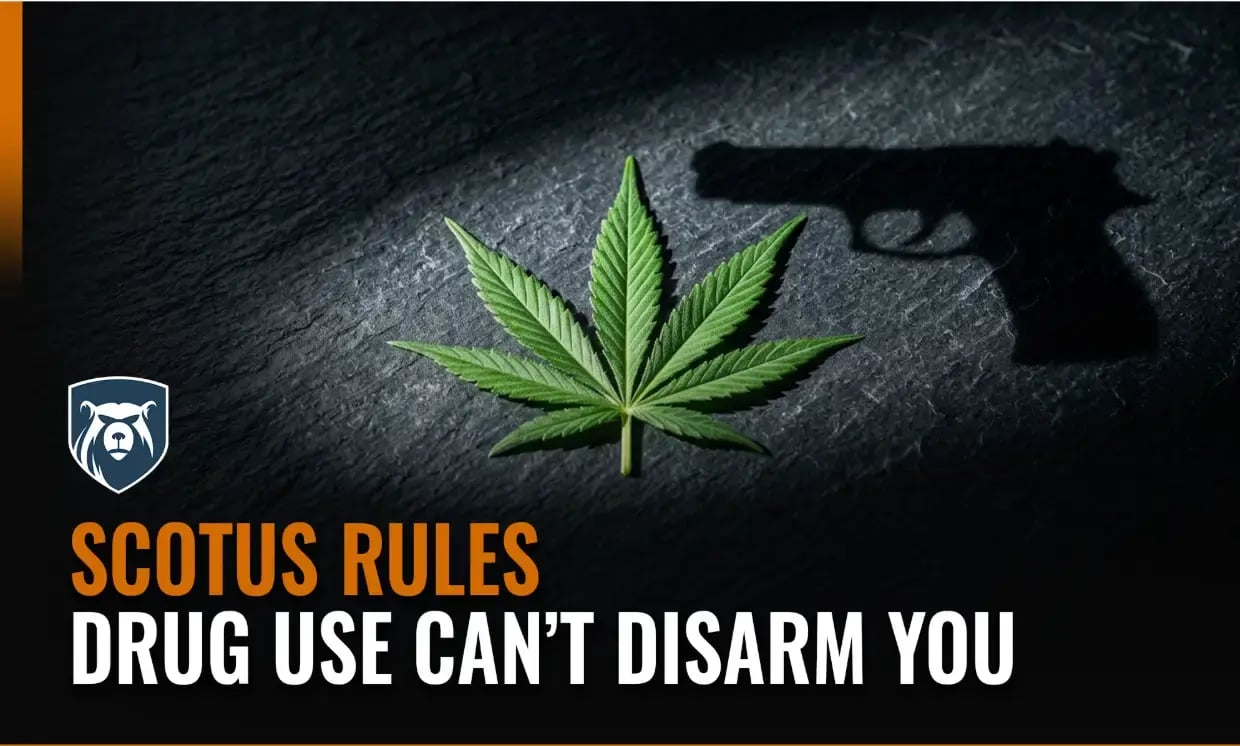
The Supreme Court ruled this week in United States v. Hemani that the federal government cannot strip someone of their Second Amendment rights simply because they use marijuana a few times a week. The decision, authored by Justice Gorsuch and joined by every member of the Court except for a separate concurrence in the judgment, marks a meaningful check on how far Congress and federal prosecutors can stretch the Gun Control Act's restrictions on drug users.
Getting the Facts Straight on Use
Ali Hemani, a Texas-born dual citizen, became the subject of a 2022 federal search related to suspected terrorism activity. No terrorism charges ever materialized.
Instead, after Hemani cooperated fully with investigators, including admitting he used marijuana about every other day, the government waited more than six months and indicted him on a single charge: possessing a firearm while being an unlawful drug user under 18 U.S.C. §922(g)(3).
For that alone, he faced up to 15 years in prison and a lifetime ban on owning a gun.
Want more content like this?
Stay connected with the latest news, updates, and special offers. Join our community by signing up for our newsletter today!
A Statute With Almost No Limits
What made the government's case so striking was not the facts, but the theory behind it. The Justice Department argued that §922(g)(3) disarms a person automatically the moment they become a regular user of any substance on any of the five schedules of the Controlled Substances Act, for any reason, regardless of dosage, frequency, or whether that use has ever made them a danger to anyone.
A nightly Ambien user taking a spouse's prescription. A college student borrowing a friend's Adderall to study. Someone managing chronic pain with medical marijuana in a state where it is legal. Under the government's own framing, all of them could be swept into the same automatic, lifetime firearm ban as Hemani.
The Court was not willing to bless a theory with that much reach.
See also: Texas Gun Laws: Carry, Permits, Prohibited Places, and Key Rules
The Historical Comparison That Fell Apart
To justify §922(g)(3), the government leaned on what it called "habitual drunkard" laws from the 18th and 19th centuries, the closest historical analogue it could find for disarming people based on substance use. The Court's analysis methodically dismantled that comparison.
Historical habitual drunkard laws, the Court explained, did not target people for merely drinking regularly. Heavy drinking was simply too common in early America for that to make sense as a legal standard. The laws targeted people whose drinking left them functionally incapacitated, unable to manage their own affairs or care for their families.
The opinion's recounting of the era's drinking habits is almost comic in retrospect: John Adams with cider at breakfast, George Washington's nightly madeira, a farewell party for Washington where 55 guests reportedly worked through dozens of bottles of wine and spirits.
None of that would have qualified anyone as a "habitual drunkard" under the laws the government was citing.
Beyond targeting different people, the old laws served different purposes. Vagrancy laws were mostly about enforcing social expectations around work, not identifying dangerous individuals. Civil commitment statutes existed to protect drunkards and their families from financial ruin, not the public from violence. Surety laws the government invoked were aimed at preventing "scandal," a far cry from the violence-prevention rationale needed to justify disarming someone today.
Finally, the mechanics did not match either. The historical laws generally required some kind of legal process, a conviction, a guardianship hearing, a proceeding before a magistrate, before anyone lost a liberty.
Section 922(g)(3), by contrast, strips someone of a constitutional right automatically and immediately, with no hearing required before the deprivation itself.
A Statute Undercut by Its Own Enforcement
One of the more pointed parts of the opinion turns the government's own behavior against it: If §922(g)(3) exists to disarm categorically dangerous people, the Court asked, why has the Justice Department spent over a decade directing prosecutors to scale back marijuana enforcement? Why did the government, mid-litigation, move marijuana products from Schedule I to the less restrictive Schedule III?
Forty states now allow some form of legal marijuana use. By some surveys, more Americans now report daily marijuana use than daily alcohol use. Marijuana is especially popular with Gen Z and that trend is likely to continue. It is difficult to simultaneously tolerate and even encourage that level of legal marijuana use while insisting that the people doing it are too dangerous to be trusted with a firearm.
What the Ruling Does Not Do
It is worth being precise about the limits of this decision, because the Court was. This ruling does not touch the disarmament of drug addicts or people who are presently intoxicated. It says nothing about Congress's ability to pass new, more carefully tailored laws targeting users of specific drugs found to pose a particular risk. It leaves §922(g)(1)'s felon disarmament provision entirely alone.
Critically, it does not foreclose future prosecutions under §922(g)(3) itself, so long as the government brings actual evidence that a specific person's drug use makes them dangerous, rather than relying on bare regular use as a stand-in for danger.
In other words, the Court did not strike the law down. Rather, it struck down the government's blank-check theory of how to enforce it.
The Bigger Picture
What makes Hemani notable is not just the outcome for one defendant in Texas, but what it signals about how the post-Bruen historical analysis framework is actually functioning in practice. The government tried to stretch a real historical tradition, restrictions on habitual drunkards, far beyond its original shape to cover a sweeping modern prohibition.
The Court's unanimous core holding suggests there is a meaningful limit to that kind of stretching, even among justices who disagree sharply about whether the historical test itself is the right tool for the job, as Justice Jackson's separate concurrence makes clear.
For the millions of Americans living in states where marijuana is legal, or who use other controlled substances under circumstances far removed from incapacitation, the ruling offers a clear marker: regular use of a substance, standing alone, is not enough to justify stripping someone of a constitutional right.
The government will need actual evidence of danger.
Why Rulings Like This Make Legal Protection Worth Having
Hemani won, but it took a Fifth Circuit appeal and a trip to the Supreme Court to get there, and that path is not cheap or fast for the average person caught in the gap between an ambiguous federal statute and an aggressive prosecutor.
Whatever the merits of his case, Hemani needed competent legal representation through multiple rounds of litigation just to establish that the government's theory had no basis in the law. Most people do not have that kind of legal runway sitting in a savings account.
This is exactly the gap a Right To Bear membership is built to close. Criminal Defense Protection covers 100% of attorney fees for a covered legal defense, for both the initial case and any appeal, with the freedom to choose your own attorney rather than whoever happens to be available.
Had Hemani been a Right To Bear member, the cost of fighting an unconstitutional prosecution all the way to the Supreme Court would not have fallen entirely on him. If a firearm is seized as part of an investigation like this one, Firearm Replacement coverage helps make that loss less disruptive, and if a case stretches on for months while a person is out of work managing depositions and court dates, Lost Wage Protection helps absorb some of that financial pressure.
Rulings like Hemani are a reminder that the line between a lawful gun owner and a federal indictment can be thinner, and more arbitrary, than most people assume. Having legal protection in place before that line gets tested is about making sure that if the government does overreach, you have the resources to push back.
Sign up for a Right To Bear membership today and make sure that protection is already there before you ever need it.
ONE WRONG MOMENT SHOULDN'T COST YOU EVERYTHING
Carry with confidence. Right To Bear backs you with 24/7 attorney-answered support and full legal defense — no caps, no deductibles. Become a member today.