How to Get a Concealed Carry Permit in Delaware (2026 Guide)

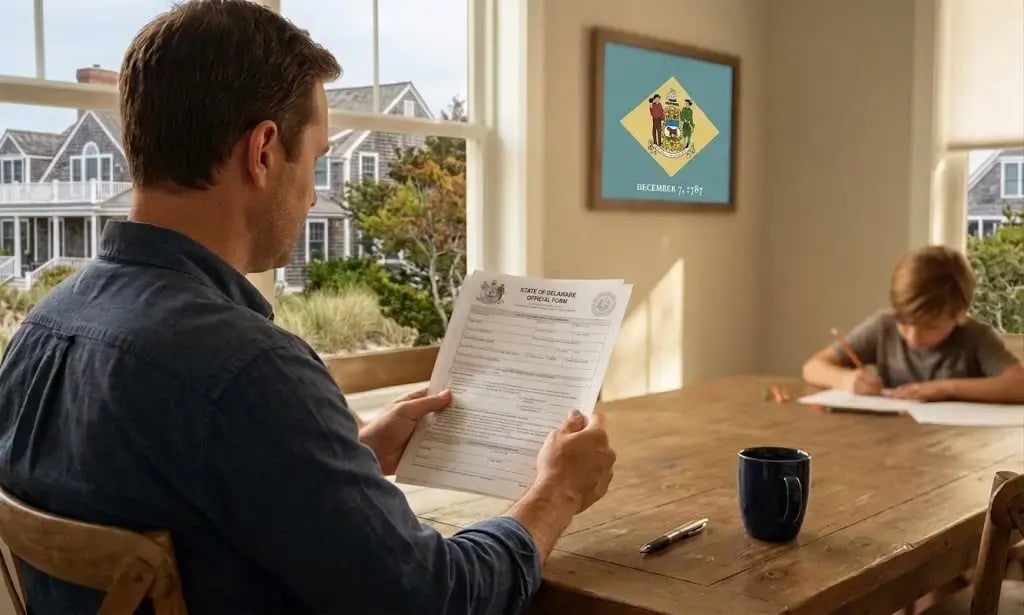
Delaware's concealed carry process does not look like most states'. There is no licensing division at the state police and no online portal that issues a permit. You file a petition in court, publish your name in the newspaper, get five people to vouch for you, and wait for a judge to rule.
Most people who give up on it give up on the same two or three steps. This guide walks through the whole process in order — who qualifies, what the newspaper notice involves, how to handle the five references, what training Delaware requires and when you take it, what it costs, and how renewal works.
Requirements at a glance
|
Requirement |
What Delaware asks for |
|---|---|
|
Who issues the license |
Delaware Superior Court, filed with the Prothonotary in your county |
|
Name of the license |
CCDW — License to Carry a Concealed Deadly Weapon |
|
Residency |
You file in the Delaware county where you live: New Castle, Kent, or Sussex |
|
Character standard |
"Full age, sobriety and good moral character" under the statute |
|
References |
5 citizens of your county who have known you at least 1 year, not related to you, not at your address |
|
Newspaper notice |
Published once before you file, with an affidavit of publication in your packet |
|
Fingerprints |
Taken by the State Bureau of Identification within 45 days before filing, scheduled through IdentoGO |
|
Photos |
Two passport-style color photos taken within the previous six months |
|
Training |
Certified firearms course including at least 100 rounds of live fire — completed after approval |
|
Filing fee |
$65 to the Prothonotary (other costs apply) |
|
Initial term |
3 years |
|
Renewal term |
5 years |
Do you need a permit to carry a concealed handgun in Delaware?
Yes. Delaware requires a License to Carry a Concealed Deadly Weapon — a CCDW — issued by the Superior Court in the county where you live. Delaware is not a constitutional carry state, and there is no permitless concealed carry option.
One note before going further: this covers the State of Delaware, not Delaware County, Pennsylvania or Delaware County, Ohio. Those turn up in the same searches and have completely different processes.
Delaware calls it a CCDW. You will see it written as a CCW or a concealed carry permit, but the court, the Prothonotary, and the Department of Justice all use CCDW, and so do the forms.
Here is the piece that explains everything below: in Delaware, a judge issues the license — not a sheriff, not a state licensing bureau. Your application is a petition to the Superior Court, reviewed by the Delaware Department of Justice and decided by a judge. That is why the process includes steps you will not find in Florida or Arkansas.
Delaware does allow adults to openly carry a firearm without a license, subject to location restrictions and other rules. A CCDW holder is also exempt from Delaware's separate Permit to Purchase requirement for handguns.
Who is eligible for a Delaware concealed carry license?
To apply for a CCDW, you generally need to be:
- A resident of the Delaware county where you file
- Of "full age, sobriety and good moral character," in the statute's language
- Not prohibited from possessing a firearm under state or federal law
- Able to state a particularized need — that carrying is necessary for the protection of yourself, your property, or both
On age: the licensing statute uses the term "full age," which Delaware defines as 18 or older. Separately, Delaware law restricts the purchase and possession of most firearms by people under 21, with limited exceptions. Sort out where you stand on that before you spend money on the process.
"Good moral character" is a discretionary standard, and it matters. The court and the Department of Justice apply it, and they look at more than felony convictions. Arrest and conviction history, protective orders, and prior mental health commitments can all factor in. Being eligible to own a firearm under federal law is not the same thing as satisfying Delaware's standard for a license.
County residency is a filing rule, not a formality. You file in New Castle, Kent, or Sussex based on where you live, and your five references have to come from that same county. If you have lived in Delaware less than five years, the court also asks for a certified driving record from each state you lived in before.
Non-residents: Delaware does not offer a general non-resident CCDW. The Attorney General may issue a temporary license to a non-resident with a short-term, employment-related need — but those licenses expire 30 days after they are issued, and a person can receive no more than three of them. If you live in another state and want to carry in Delaware, reciprocity is almost always your answer, not an application.
Explore the RIGHT TO BEAR CONCEALED CARRY RECIPROCITY MAP
What are the steps to apply for a Delaware CCDW, in order?
New applications may be filed at any time. The order matters more than most people expect:
- Publish your newspaper notice. This runs first — there is a required waiting period before you can file.
- Get your five reference questionnaires completed and notarized. Start this the same week you start everything else. It is the step that stalls applications.
- Get fingerprinted through the State Bureau of Identification. Appointments are scheduled through IdentoGO using your county's service code. Prints must be taken within 45 days before you file, and proof of payment goes in the packet.
- Gather the rest of the packet. Two passport-style color photos taken within the last six months, and — if you have been a Delaware resident less than five years — certified driving records from your previous states.
- Complete and notarize the Superior Court application. Each Prothonotary's office has a notary available at no charge.
- File with the Prothonotary in your county, with the $65 filing fee and every attachment: the publication affidavit, the five reference certificates, and your fingerprint payment proof.
- The Department of Justice reviews your application and returns it to the court with its position.
- A Superior Court judge rules on the petition.
- If approved, complete your firearms training course and file the notarized certificate with the court within the deadline. This step comes after approval, not before.
- The license is issued.
Two things most guides get backwards: the newspaper notice runs before you file, and the training course comes after the judge approves you. Getting either out of order costs you time and money.
Can you apply online? No. The forms are downloadable from the Delaware Courts website, but the completed packet is filed in person or by mail with your county Prothonotary — New Castle County in Wilmington, Kent County in Dover, Sussex County in Georgetown. Check each step against the court's current "Instructions for New Applications" sheet, since forms and service codes are updated periodically.
Do you really have to publish your name in the newspaper?
Yes. Delaware requires public notice of your CCDW application in a newspaper circulating in your county, and you cannot file until it has run.
This requirement is close to unique to Delaware, and it is the most common reason people abandon the process.
Here is how it works in practice. Under the court's current instructions, you arrange publication yourself with an approved newspaper in your county — the instruction sheet lists which papers qualify for each county. The notice runs once, at least 10 business days before you file. You then get an affidavit of publication from the newspaper and include it in your packet. No affidavit, no filing.
Worth knowing: the statute itself is written as though the Prothonotary handles publication, while the court's instruction sheet puts it on the applicant. The instruction sheet is what the Prothonotary's office works from day to day, so call your county office and confirm current practice before you place anything.
On the privacy question — because that is what most people are really asking — this is a legal notice in the classified section, not a state database. It exists because the statute was written to give the public a chance to object before the court ruled. It is not a searchable registry of Delaware permit holders. Some people are fine with that and some are not. Decide on the facts rather than the rumor.
A few practical points that save time:
- Call the newspaper's legal notices desk directly, not the main line.
- Say specifically that you need a CCDW legal notice.
- Confirm the cost and the run date up front.
- Ask for the affidavit of publication when you place the ad, not after.
Budget for this as a separate out-of-pocket cost on top of the $65 filing fee. The price varies by publication, so confirm it when you call.
Who can be one of your five references?
Your five references must be citizens of the same Delaware county where you are filing, who have known you for at least one year, who are not related to you, and who do not live at your address. Each one completes a questionnaire certifying that you are of full age, sober, and of good moral character, and that they believe carrying is necessary for your protection.
People get stuck here because they assume a reference has to be someone impressive. It does not. Realistic options:
- Coworkers and supervisors
- Neighbors
- Members of your congregation
- Fellow club or range members
- A longtime barber, mechanic, or landlord
It has to be someone who lives in your county and has known you a year. That is the whole test.
If you just moved to Delaware, the binding constraint is usually not your own residency — it is the one-year requirement on the people vouching for you. If you have been in the state under a year, you may simply have to wait until you have built those relationships. That is an unsatisfying answer, and it is the honest one. Every requirement here is built to be satisfied truthfully, not worked around.
Make it easy on them: hand over the form with your details already filled in, say up front that notarization is required, and give a deadline. Expect this step to take longer than any other.
What firearms training does Delaware require, and when do you take it?
You take the training course after your application is approved, not before — and you have 90 calendar days from approval to file your certificate with the court.
Miss that window and you can be sent back to the start of the process. Book the class the week your approval comes through.
Delaware sets the course content by statute. An approved course covers safe handling and storage of firearms and ammunition, the fundamentals of marksmanship, care and cleaning, safe handling on a range, federal and Delaware firearms law, Delaware's use-of-force and self-defense law, and how to avoid a violent confrontation. It also requires live fire on a range with a minimum of 100 rounds of ammunition.
Is there a test? There is no state-administered written exam. Your instructor certifies that you completed a qualifying course, and you file that original notarized certification with the court. An instructor is signing their name to your completion, so expect a real class.
When choosing one, the questions are whether the course meets Delaware's statutory content requirements and whether you will receive an original, notarized certificate. A generic online safety course does not satisfy this.
What does it cost, how long does it take, and can you be denied?
The $65 filing fee is the smallest part of your total cost. Plan for:
- Court filing fee — $65 to the Prothonotary
- Fingerprinting through IdentoGO
- Newspaper publication
- Passport photos
- Notarizations (free at the Prothonotary's office for the application itself)
- The firearms training course
The training course and the newspaper notice are the variable pieces, and together they typically dwarf the filing fee. Confirm current amounts with your county Prothonotary and the newspaper before you budget.
Timing: think in months, not weeks. How long it takes depends on how fast you collect five notarized reference forms, the newspaper's schedule, the Department of Justice review, the court's calendar, and your 90-day training window after approval. For a status update on a pending application, contact the Prothonotary's office where you filed.
Can you be denied? Yes. A Delaware judge has discretion, and applications are denied. The realistic reasons:
- An incomplete or improperly notarized packet
- A missing affidavit of publication
- Fewer than five qualifying references
- A disqualifying criminal or protective order history
- An objection from the Department of Justice
- A statement of need the court does not find persuasive
Denials come by written notice. The encouraging part: most failures a law-abiding applicant runs into are paperwork failures, and those are avoidable if you check the packet carefully before filing.
How long does a Delaware CCDW last, how do you renew it, and where is it honored?
An initial Delaware CCDW is valid for three years. Renewals are granted for five years at a time. Mark both dates when you get your license.
Renewal is much lighter than the initial application. You file a renewal application with the Prothonotary, with new photos and the $65 renewal fee. You are not repeating the newspaper notice and you are not gathering five new references. The window is narrow: after January 1 and no later than June 1 of the year your license expires.
That deadline is the whole point of this section. Let a Delaware license lapse and you can be sent back to the beginning — new application, new newspaper notice, five new reference forms. Renew on time, and confirm the current renewal requirements with your Prothonotary's office when you file.
Reciprocity: Delaware honors concealed carry licenses from a defined list of states whose licensing systems provide a reasonably similar degree of protection to Delaware's, and it recognizes both resident and non-resident licenses from states on that list. The Delaware Attorney General publishes and updates that list annually, so check the current list rather than an old article before you travel — and check our reciprocity map for where a Delaware CCDW is honored.
One last thing worth sitting with. By the time Delaware hands you a license, you have cleared a public notice, five character references, a background check, a Department of Justice review, a judge, and a live-fire course. None of that helps on the day you actually have to defend yourself. What follows a self-defense incident is a criminal investigation and, potentially, a civil lawsuit.
Frequently asked questions
What is the new gun law in Delaware?
Delaware has passed several firearms laws in recent years, including a Permit to Purchase requirement for handguns. CCDW holders are exempt from that purchase permit requirement. State firearm law changes regularly, so confirm current rules with the Delaware Department of Justice or Delaware State Police.
What states are reciprocal with Delaware concealed carry?
Alabama, Alaska, Arizona, Arkansas, Colorado (resident permit only), Florida, (resident permit only) Idaho, Indiana, Iowa, Kansas, Kentucky, Maine, Michigan (resident permit only), Minnesota, Mississippi, Missouri, New Hampshire, New Mexico, North Carolina, North Dakota, Ohio, Oklahoma, South Dakota, Tennessee, Texas, Utah, Vermont, Virginia, West Virginia Wisconsin
Can I carry my gun in Delaware with a Pennsylvania permit?
Delaware does not have a reciprocity agreement with Pennsylvania, meaning your PA permit is invalid for concealed carry in Delaware.
Can I concealed carry a handgun in my vehicle in Delaware?
Carrying a concealed firearm in a vehicle in Delaware generally requires a CCDW, and separate rules apply to transporting an unloaded, cased firearm. Vehicle carry is part of Delaware's broader gun laws rather than the CCDW process — see our Delaware gun laws guide.
ONE WRONG MOMENT SHOULDN'T COST YOU EVERYTHING
Carry with confidence. Right To Bear backs you with 24/7 attorney-answered support and full legal defense — no caps, no deductibles. Become a member today.