

"Gun insurance" is a common term that refers to, and sometimes combines, two completely different products. One insures the firearm itself as property. The other covers the legal consequences of using one.
They're sold by different types of companies, priced in different ways, and protect against risks that have nothing to do with each other. One might be referring to CCW Insurance, or concealed carry weapon insurance, a membership organization that may give access to CCW Insurance like Right To Bear, or a feature included in some policies that provides firearm reimbursement for seized weapons. We’ll explore these options more below.
What Is Gun Insurance?
Gun insurance is a general term for two different products. Firearm property insurance covers the gun itself against theft, loss, fire, and damage. Gun owner liability insurance, or CCW Insurance, which is also sometimes called self-defense liability coverage, covers the legal costs a gun owner faces after a defensive use of force. The two are sold by different types of companies, cost different amounts, and cover risks that have nothing in common with each other.
All the different terms and popular names for these services can definitely get confusing, but here's a simple breakdown:
|
Firearm Property Insurance |
Gun Owner Liability Insurance (CCW Insurance) |
|
|
Insures |
The firearm |
The owner |
|
Pays for |
Replacement or repair after theft, loss, fire, damage |
Attorney fees, bail, civil damages after a defensive incident |
|
Triggered by |
Something happening to the gun |
Something happening with the gun |
|
Typical buyer |
Collector, competitive shooter, someone traveling with firearms |
Anyone who carries or keeps a firearm for defense |
What Does Firearm Property Insurance Cover?
Firearm property insurance works much like insuring any other valuable personal property. It typically covers:
- Theft and burglary
- Loss and mysterious disappearance
- Fire and flood damage
- Accidental damage in transit or at the range
- Accessories, including scopes, rings, mounts, and slings
- Newly acquired firearms, usually for a set window of time before they need to be individually scheduled
- Coverage while traveling, including internationally, typically with a dollar cap and a time limit
What it does not do is just as important: it does not pay a lawyer, it does not cover anything that happens after you use the firearm, and it does not respond to a self-defense incident in any way. It's strictly about the physical item.
Property coverage is generally written one of two ways.
- Scheduled coverage lists and values each firearm individually, which is what a collector with high-value pieces typically needs to get fair replacement value.
- Blanket, or unscheduled, coverage instead sets a single total limit across an entire collection, which works better for someone with a handful of firearms of similar, modest value.
Does Homeowners Insurance Already Cover Your Guns?
Homeowners and renters policies do cover firearms as personal property, but most apply a special theft sublimit to firearms that sits far below the value of even a modest collection, commonly around $2,500, with a deductible applying on top of that.
Generally, owning a gun doesn’t increase your homeowners insurance. Firearms are treated as ordinary personal property, and simply owning one doesn't by itself change your premium. Scheduling a high-value firearm as an endorsement does add cost, but that's because it adds coverage, not because of the firearm itself.
Homeowners and umbrella policies are built for accidents. A deliberate act of self-defense, even a lawful one, usually runs into an intentional-act or use-of-force exclusion, and neither policy pays for criminal defense at all.
For a full breakdown of exactly how that exclusion works, see Does umbrella insurance cover self-defense?
What Is Gun Owner Liability Insurance?
Gun owner liability insurance is coverage that responds after a firearm is used defensively, paying the legal costs the owner faces, criminal defense attorney fees, bail, civil defense, expert witnesses, rather than replacing any property.
Coverage of this kind typically includes:
- Criminal defense attorney fees
- Civil defense and civil damages
- Bail or bond
- Expert witnesses and investigators
- Lost wages for court appearances
Coverage like this is usually delivered through a membership association like Right To Bear which provides access to a CCW Insurance policy, rather than sold as a standalone insurance policy. This is why searching for "gun insurance" turns up a mix of insurance carriers and membership organizations. It's also why the results for this search term look so scattered, they're actually answering two different questions at once.
This type of coverage applies to lawful acts of self-defense, and the specific terms, coverage caps, and whether legal costs are paid upfront or reimbursed after the fact all vary meaningfully from one program to another.

Which Type of Gun Insurance Do You Need?
This is the question the search itself is actually asking, so here's a direct answer.
|
If this is what you're worried about |
You want |
Why |
|
My collection is worth more than my homeowners policy will pay |
Firearm property insurance |
Homeowners theft sublimits are low; scheduled coverage pays fair market value |
|
I travel or compete with my firearms |
Firearm property insurance |
Covers loss and damage away from home |
|
I inherited or bought a high-value piece |
Firearm property insurance |
Needs scheduling and a documented valuation |
|
I carry for self-defense |
Gun owner liability insurance |
Property coverage pays nothing toward a legal defense |
|
I keep a firearm at home for defense |
Gun owner liability insurance |
The exposure is legal, not financial loss of the gun |
|
I want both |
Both, they are separate purchases |
No single product covers both risks |
The two are not alternatives to each other, and buying one does not give you any of the other. They solve entirely different problems.
If you do decide you need property coverage, documenting your collection makes the process much smoother regardless of which carrier you choose: make, model, serial number, photographs, and a current valuation for each firearm you want covered.
It costs nothing to put together and it's the single most useful thing you can do before applying.
Do You Need Gun Insurance? Is It Required by Law?
No federal law requires a firearm owner to carry insurance, and firearm liability insurance is not a general condition of ownership or of carrying a concealed weapon.
“Not required" is not the same as "not needed." Property coverage is a financial decision about replacement cost if something happens to your firearms. Liability coverage is a decision about legal exposure if you ever have to use one.
Neither is mandated by law in the vast majority of places, but both get purchased for real reasons.
How Much Does Gun Insurance Cost?
|
Firearm Property Insurance |
Gun Owner Liability Coverage |
|
|
Priced on |
Declared value of the firearms |
Flat membership rate |
|
Typical structure |
Annual premium scaled to insured value, plus a per-claim deductible |
Monthly or annual, no deductible on covered legal costs |
|
What moves the price |
Collection value, scheduled vs. blanket, storage |
Coverage tier and limits |
On the property side, published sample rates from a named firearm insurance program run roughly $62.50 per year on $5,000 of insured value, up to $187.50 per year on $15,000 of insured value, with a $250 deductible, which works out to approximately $12.50 per $1,000 of insured value annually.
On the liability side, a Right To Bear membership starts at $19 per month and includes access to CCW insurance as well as other important benefits exclusive to the membership itself like a 24/7/365 attorney-answered hotline, training content, and more..
You can see full membership pricing for details on what each tier includes to give you a good example of what a typical self-defense membership might cost.
Jurisdiction Example: Gun Insurance in Texas
Texas has no state requirement to insure a firearm or to carry liability coverage tied to gun ownership. Property coverage in Texas is written by the same national carriers that operate everywhere else in the country, so there's nothing state-specific about how firearm property insurance works if you live there.
Property coverage follows the gun, while liability coverage follows the person.
That distinction matters if you ever travel with a firearm or move states, because coverage tied to you as an individual generally travels with you, while coverage tied to a specific firearm's location or storage may not. This logic holds in any state, not just Texas.
For more detail on how coverage works across state lines, see the state coverage section on our CCW insurance page.
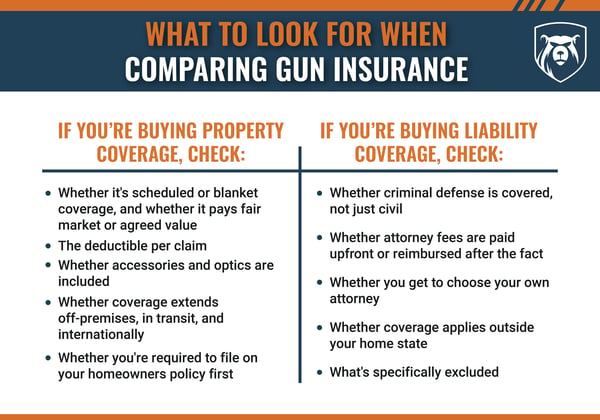
What to Look for When Comparing Gun Insurance
Rather than ranking specific companies, here's what actually matters when you're comparing options in each category.
If you're buying property coverage, check:
- Whether it's scheduled or blanket coverage, and whether it pays fair market or agreed value
- The deductible per claim
- Whether accessories and optics are included
- Whether coverage extends off-premises, in transit, and internationally
- Whether you're required to file on your homeowners policy first
If you're buying liability coverage, check:
- Whether criminal defense is covered, not just civil
- Whether attorney fees are paid upfront or reimbursed after the fact
- Whether you get to choose your own attorney
- Whether caps are per-incident or annual, and whether they reset
- Whether coverage applies outside your home state
- What's specifically excluded
Knowing which category you're shopping in from the start will save you a lot of time sorting through results that don't actually apply to what you need.
So What Do You Need: Property Insurance or CCW Insurance
"Gun insurance" covers two unlabeled products, and now you know which one you actually came here looking for.
If what you wanted was coverage for the firearm itself, that's a property carrier's job.
If what you wanted was protection from what happens legally after a defensive use of a firearm, that's CCW insurance, and a Right To Bear membership includes access to CCW insurance along with a number of other bespoke benefits like our 24/7/365 emergency and non-emergency attorney-answered hotline, giving you the ability to speak with o one our experienced gun rights lawyers at a moments notice so you’re always prepared for what comes next .
For large collectors and discerning lawful firearm carriers, you’ll probably need both to ensure your collection is protected but so if your legal and financial future should you ever find yourself in a self-defence incident. You’ve spent years building your collection, protecting them from the elements, and keeping everything in working order. Maybe for self-defence, maybe because it's your right to own them and you’re gonna exercise it. Whatever the reason, they’re your own.
Protect your property and yourself with both sides of the “gun insurance” coin. While you’re evaluating whether you need insurance for your gun collection, join Right To Bear and gain access to CCW insurance and the legal protection you deserve.
FAQ's
What is gun insurance?
"Gun insurance" is an umbrella term covering two separate products: firearm property insurance, which protects the gun itself against theft, loss, or damage, and gun owner liability insurance, which covers legal costs after a defensive use of a firearm.
Does homeowners insurance cover firearms?
Yes, but with a low sublimit, commonly around $2,500, that falls well short of most collections' value. It also doesn't cover legal costs after a self-defense incident. See does umbrella insurance cover self-defense for more on that gap.
Is gun insurance required by law?
No federal law requires it. A small number of localities have adopted their own requirements, so it's worth confirming your specific jurisdiction, but in most places neither property nor liability coverage is legally mandated.
How much does gun insurance cost?
Firearm property insurance is typically priced around $12.50 per $1,000 of insured value annually, with sample rates running from about $62.50 to $187.50 per year depending on collection value. Access to gun owner liability coverage through a Right To Bear Individual membership starts at $19 per month.
Is gun insurance the same as CCW insurance?
No. "Gun insurance" usually refers to firearm property coverage, while CCW insurance specifically covers the legal costs of a defensive use of force. A Right To Bear membership includes access to CCW insurance, which falls into the liability category, not the property category.
Membership starts at only $19 month or $205/year. You don’t need to max out your credit card to get a premium service that includes an experienced attorney and 100% attorney fees for criminal defense and civil defense.