Hawaii's Broad Anti-Concealed Carry in Private Businesses Law Struck Down in Supreme Court
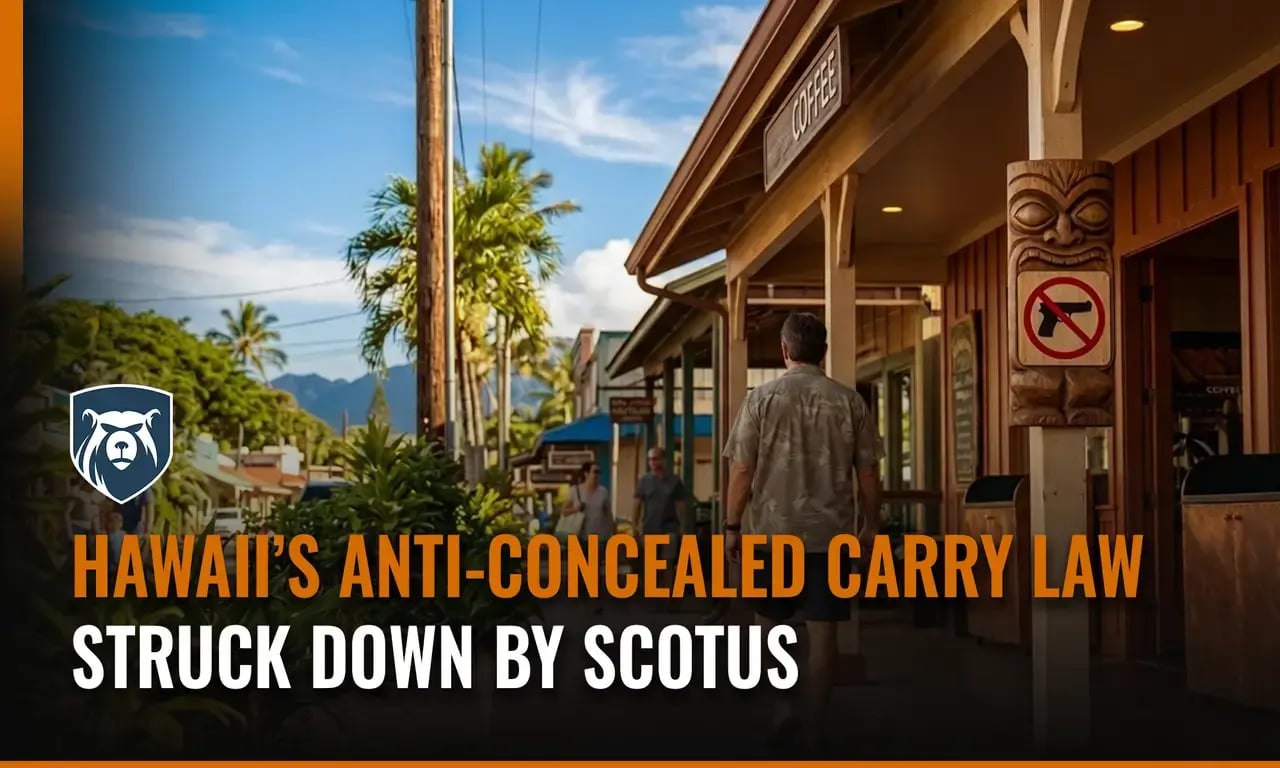
The Supreme Court handed down another significant Second Amendment ruling today. In Wolford v. Lopez, a six-justice majority struck down a Hawaii law that prohibited licensed concealed-carry permit holders from bringing firearms onto private property open to the public without the express permission of the property owner.
The decision is being framed in some quarters as another culture-war flashpoint, but the legal questions at the center of it are more nuanced than that framing suggests.
Want more content like this?
Stay connected with the latest news, updates, and special offers. Join our community by signing up for our newsletter today!
What Hawaii’s Law Actually Meant for Americans
To understand the ruling, you have to understand what Hawaii was attempting. In 2022, the Supreme Court's Bruen decision struck down New York's restrictive carry permit scheme and held that the Second Amendment protects the right to carry handguns outside the home for self-defense.
Hawaii, which had issued roughly four concealed-carry permits in nearly two decades, was forced to overhaul its system.
What the state came up with was clever, at least from a regulatory standpoint. Rather than restricting who could get a permit, Hawaii flipped the default rule on private property.
Under the traditional common law rule, opening your property to the public implies a general license for people to enter. Hawaii reversed that presumption specifically for gun owners, requiring licensed carriers to obtain affirmative express permission before entering any privately owned business or property.
The practical effect was significant.
A licensed permit holder leaving home on an ordinary day, stopping for gas, grabbing lunch, picking up dry cleaning, and shopping for groceries, could potentially commit multiple criminal violations simply by going about normal daily life without first obtaining explicit permission at each stop.
The majority painted this picture vividly, and it is difficult to read the law as written without concluding that Hawaii designed the law specifically to make licensed carry operationally impossible without technically banning it outright.
The Historical Test and Where Hawaii's Analogues Failed
The Court's Second Amendment framework, established in Heller and refined in Bruen, requires the government to demonstrate that a challenged firearm regulation is consistent with the nation's historical tradition of gun regulation.
Hawaii offered several historical analogues to justify its law, and the majority rejected all of them.
The bulk of Hawaii's historical evidence consisted of colonial-era anti-poaching laws, statutes from Pennsylvania, New Jersey, Maryland, and New York that prohibited unauthorized hunting on enclosed private land without the owner's permission.
The majority acknowledged these laws but found the gap between them and Hawaii's default rule too wide to bridge.
Those colonial laws targeted a specific, concrete harm: armed trespassers who damaged crops, stole game, injured livestock, and posed physical danger through the indiscriminate firing of weapons on working farmland. They applied to enclosed agricultural property where poaching was a genuine problem.
Not once did the framers of old colonial law mean for this to impact the kind of peaceful concealed carry that occurs when someone walks into a coffee shop or a hardware store with a holstered firearm that no one around them will even notice.
Hawaii's remaining analogues fared even worse.
An 1893 Oregon law was a single outlier from nearly a century after the Second Amendment's adoption, which the Court found carried little evidentiary weight. A 1865 Louisiana statute Hawaii cited turned out to be part of that state's Black Code, legislation explicitly designed to disarm freed Black Americans and leave them defenseless.
The majority's rejection of that analogue, with Justice Barrett's concurrence going into considerable historical detail about the Black Codes' true purpose, was both constitutionally and morally straightforward.
The "Spirit of Aloha" Argument
Hawaii also made a broader argument that its unique history of firearm restriction, dating back to King Kamehameha III's 1833 prohibition on deadly weapons, supported a local interpretation of Second Amendment rights that accommodated Hawaiian customs and attitudes.
The Court dispatched this argument quickly and sharply.
The Second Amendment, the majority wrote, cannot give way to the "spirit of Aloha" in Hawaii any more than it yielded to the spirit of the Big Apple in Bruen or the spirit of the Windy City in McDonald.
The Bill of Rights, as incorporated against the states through the Fourteenth Amendment, establishes a uniform national standard. Local attitudes, however genuinely held and long-standing, cannot shrink or expand what a constitutional right means.
This is not a new principle. It is the same principle that required Alabama to follow the same First Amendment rules as Massachusetts, and the same Eighth Amendment rules as California.
A state with a genuinely different cultural relationship to firearms than, say, Wyoming, still has to operate under the same constitutional framework.
Who Dissented and Why?
Justice Kagan dissented briefly, largely agreeing with Justice Jackson's more extensive dissent that Hawaii's historical analogues were sufficiently similar to its law to survive constitutional scrutiny.
The core of the disagreement between the majority and the dissenters is a familiar one in post-Bruen cases: how narrowly or broadly to read historical analogues.
The dissenters argued that the majority was demanding too close a match, effectively requiring a historical twin rather than a historical principle. The founding-era anti-poaching laws, they contended, stood for the broader principle that states could require express consent for armed entry onto private property to protect property owners' rights and prevent harms from unauthorized armed presence.
Hawaii's law did the same thing for the same underlying reasons, just applied to a modern context where poaching is not the relevant harm.
Justice Barrett's concurrence pushed back on this, arguing that Hawaii's law was not targeted at any specific abuse of firearms at all but was simply a response to generalized public discomfort with armed carry. The distinction matters under the Bruen framework. Colonial legislatures identified specific places prone to specific harms and crafted focused regulations to address them. Hawaii applied its default rule to all private property everywhere, from hardware stores to gas stations, without showing that any particular harm was occurring there that needed to be addressed.
Justice Jackson's dissent also raised a genuinely difficult question about the use of Black Codes as historical analogues, one the majority did not fully engage with. If courts are committed to a history-and-tradition methodology, they cannot simply excise uncomfortable parts of that history without explaining the principle by which they are doing so.
The majority's categorical rejection of the Louisiana Black Code statute as an analogue, while morally satisfying, left unanswered questions about how courts should handle historically racist laws that may nonetheless tell us something about the understood scope of constitutional rights at the time.
What This Means Going Forward for Americans
The immediate practical effect of Wolford is that Hawaii, California, New Jersey, Maryland, and New York, the other states that adopted similar default rules after Bruen, are now on notice that those laws face a difficult constitutional path.
Cases challenging similar statutes in those states will now proceed against the backdrop of a Supreme Court majority that has made clear it views this kind of default-flipping as an unconstitutional burden on licensed carry.
More broadly, Wolford reinforces the pattern that has emerged in post-Bruen Second Amendment litigation. States that attempt to work around Bruen through indirect means, rather than identifying specific places or circumstances with genuine and historically grounded justifications for restricting carry, are going to have difficulty before this Court. The majority is clearly skeptical of regulatory creativity that achieves through property law what cannot be achieved through direct carry restrictions.
What the decision does not do is eliminate the ability of individual property owners to prohibit firearms on their premises. That right remains fully intact.
Private businesses can still post signs, adopt policies, and exclude armed customers as they see fit. The ruling is about who sets the default, not about who has the ultimate say. Property owners retain their power. States simply cannot set the baseline in a way that effectively strips licensed carriers of their constitutional rights as they go about ordinary daily life.
The majority's core holding, that a state cannot neutralize a constitutional right through a procedural default rule while leaving the formal right technically intact, is a defensible principle that extends well beyond the Second Amendment context.
The fed keeps an eye on the country at large, the states watch over their constituents in towns no federal legislator will ever hear of, and within that small town is a coffee shop where the owner should have the power to decide if firearms can be allowed on their premises.
ONE WRONG MOMENT SHOULDN'T COST YOU EVERYTHING
Carry with confidence. Right To Bear backs you with 24/7 attorney-answered support and full legal defense — no caps, no deductibles. Become a member today.