First Circuit Court Unanimously Rules to Uphold Massachusetts' AR-15 Ban
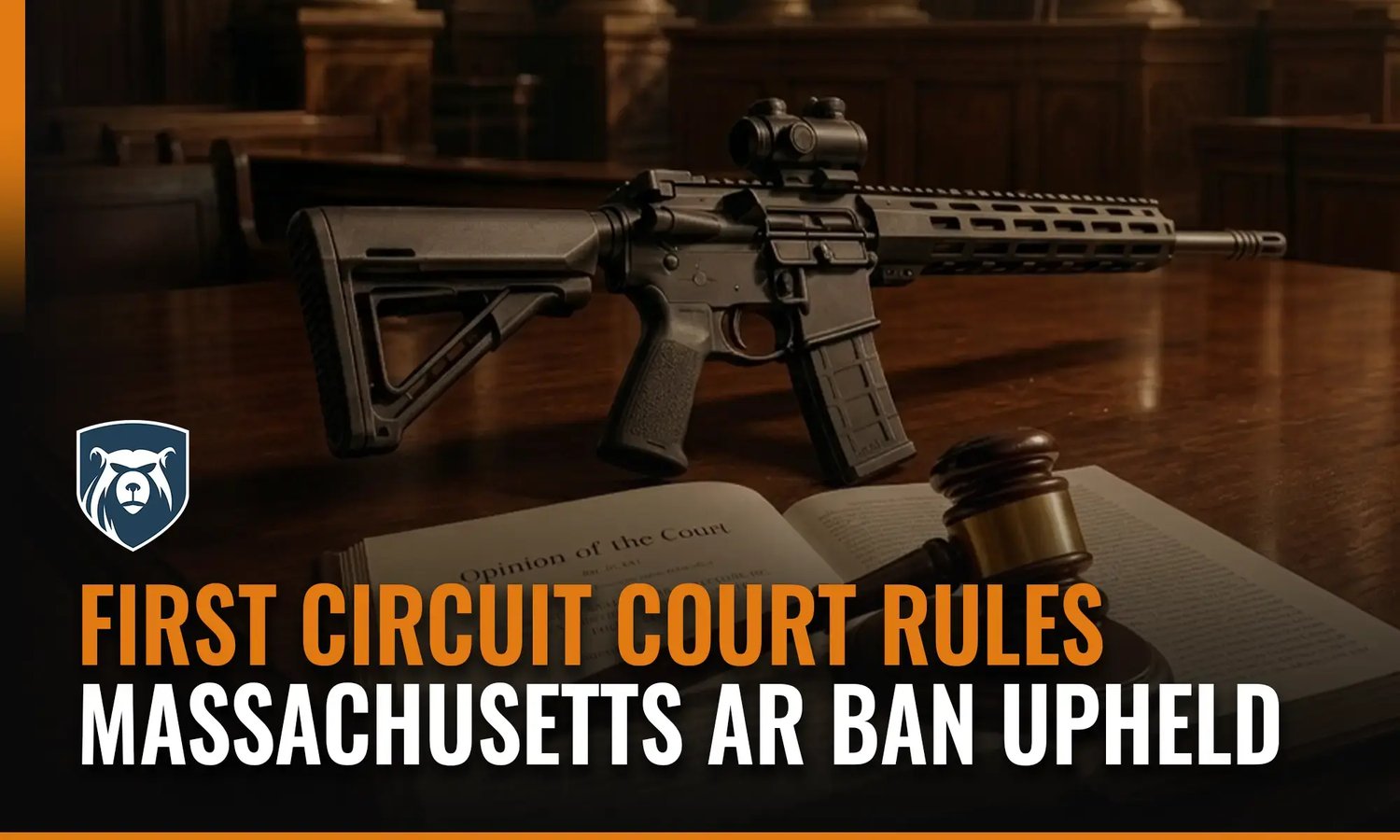
Four days after the Third Circuit became the first federal appeals court in history to strike down a state assault weapons ban, the First Circuit went the other direction.
Want more content like this?
Stay connected with the latest news, updates, and special offers. Join our community by signing up for our newsletter today!
A unanimous three-judge panel upheld Massachusetts' prohibition on AR-15s and similar semi-automatic rifles, declining to revive a challenge brought by a Massachusetts gun store owner.
The ruling was not unexpected, and in an important sense it was not even a substantive Second Amendment decision, but rather a procedural one. That distinction matters as this case will no doubt barrel forwards towards the Supreme Court and finally some finality on the AR-15 question.
What the Court Actually Did and Did Not Do
The First Circuit did not conduct a fresh analysis of whether Massachusetts' assault weapons ban passes constitutional muster under the Bruen framework. The panel held that its own prior ruling in Capen v. Campbell, which upheld an earlier version of the same law, controlled the outcome and that the plaintiff's new arguments were not sufficiently distinct to require a different result.
Dissecting this, the court essentially said it had already decided this question and was not revisiting it.
That is a fundamentally different posture from the Third Circuit's careful, detailed analysis of why New Jersey's ban could not survive Bruen scrutiny. The First Circuit was not persuaded that anything had changed enough to require reopening a question it considered settled at the circuit level.
The plaintiff, gun store owner Gino Mario Recchia, did attempt to bring a new argument to the table. He argued that the Second Amendment must protect weapons equivalent to those carried by the modern military, reasoning that meaningful “resistance to tyranny” requires access to arms comparable to those the government itself uses.
The court dispatched this argument quickly and did so on solid ground, citing Heller directly for the proposition that the Supreme Court had already rejected the idea that the Second Amendment guarantees an individual right to possess weapons equivalent to those carried by soldiers.
Whatever one thinks about the broader assault weapons debate, this specific argument was never going to succeed given what Heller said.
The government, even Republican led-ones, have made it very clear in years past that you can and should own all the guns you want but they will never allow a person to walk into a store and purchase a weapon equivalent to what the U.S. he military itself uses. Look no further than the legal definition between “assault rifle” and “assault weapon” to get an idea of how these two terms, while similar, are explicitly different to the law.
This argument was doomed to fail and hurt the broader 2A movement, at least if we lived in a time when the nation’s Supreme Court was not eager to settle the argument and soon.
Three Appellate Decisions in One Month
The pace of Second Amendment litigation right now is worth pausing on. In roughly a three-week span this July, three federal appeals courts issued three different rulings on state assault weapons bans. The Seventh Circuit upheld Illinois' ban. The Third Circuit struck down New Jersey's ban. The First Circuit upheld Massachusetts' ban. Three courts, applying the same Supreme Court framework, reached conclusions that cannot all be correct.
This is precisely the kind of circuit conflict that makes Supreme Court intervention not just likely but necessary. Courts are not supposed to apply constitutional protections inconsistently based on geography. The Second Amendment either permits bans on commonly owned semi-automatic rifles or it does not, and that question cannot have a different answer in New Jersey than it does in Massachusetts or Illinois.
The Supreme Court has already signaled it understands this. The Court recently agreed to hear challenges to assault weapons bans in Connecticut and Illinois, positioning the justices to resolve the question that is currently producing contradictory results across the circuits. The First Circuit's ruling this week, much like the Seventh Circuit's ruling before it, is essentially a placeholder that will be overtaken by events within the next Court term.
The Precedent Problem
There is something worth examining in the First Circuit's approach here. By leaning heavily on its own prior precedent in Capen rather than conducting a fresh Bruen analysis, the panel chose institutional continuity over substantive engagement with the Second Amendment question. That is a defensible judicial choice in normal circumstances. Stare decisis, the principle of respecting prior decisions, exists for good reasons.
The problem is that Second Amendment law has not been in a normal state since Bruen fundamentally changed the analytical framework in 2022. Courts that applied pre-Bruen reasoning to uphold restrictions were doing so under a framework the Supreme Court explicitly rejected. Prior circuit precedent built on that old framework is not the kind of settled law that stare decisis is meant to protect. This is exactly the kind of precedent that needs to be reconsidered in light of what the Supreme Court has since said.
The Third Circuit recognized this. Its en banc decision engaged directly and exhaustively with what Bruen requires and concluded that no historical tradition supports banning an entire class of commonly owned firearms. The First Circuit effectively declined that invitation and deferred instead to what it had said before.
Those two approaches will be reconcilable only after the Supreme Court speaks definitively on the question.
What This Means for Gun Owners
For gun owners in Massachusetts, nothing changes yet. The ban remains in place, the ruling does not open any new challenges at the circuit level, and the path forward runs through the Supreme Court rather than through further First Circuit proceedings.
It doesn’t even mean Mass. residents won’t have some form of access to similar weapons. As one user on Reddit pointed out, he was able to purchase a Scar-17 legally in the state with the AR-15 ban. This ban is specifically referencing the AR-15 platform, which has continuously been targeted for political and public awareness reasons rather than with any meaningful attempt to curtail the purchase of so-called “assault weapons”.
For gun owners nationally, the significance of this ruling is less about its specific outcome and more about what it represents in the larger picture. The circuit courts are now openly split on one of the most consequential Second Amendment questions in decades. That split, combined with the Supreme Court's decision to take up the Connecticut and Illinois cases, creates a timeline where a definitive national answer on assault weapons bans is coming, likely within the next year.
What that answer looks like will depend on how the Supreme Court applies the principles it has established in Heller, McDonald, Bruen, and the more recent cases.
The Third Circuit's careful historical analysis provides one detailed roadmap. The First Circuit's deference to prior precedent provides another.
The justices will have to choose between those approaches, and the choice will shape the Second Amendment landscape for years to come.
The Bigger Picture for Responsible Gun Owners
At Right To Bear, we follow these legal developments closely because they directly affect the rights and legal exposure of the responsible gun owners we serve. The current state of the law, where your rights depend significantly on which circuit you live in, is an unstable situation that demands attention.
What this month's flurry of appellate decisions makes clear is that the legal landscape around firearms is in genuine flux, and that the rules governing what you can own, where you can carry, and how your defensive use of force is evaluated vary considerably depending on where you live and, increasingly, on which court is doing the evaluating.
The Supreme Court will have the last word on assault weapons bans, and that word is coming soon.
In the meantime, the split among the circuits is a reminder that the legal protections gun owners rely on are not as settled as they might appear, and that preparation, both in terms of knowing the law and having the right legal protection in place, matters more than ever.
ONE WRONG MOMENT SHOULDN'T COST YOU EVERYTHING
Carry with confidence. Right To Bear backs you with 24/7 attorney-answered support and full legal defense — no caps, no deductibles. Become a member today.