What Is Open Carry?
Open carry means carrying a firearm in public where it can be seen, usually in a holster on your hip or on a sling, instead of hidden from view. It is different from concealed carry, which keeps the firearm out of sight, and from permitless carry, which is about whether you need a permit at all.
Three quick contrasts clear up most of the confusion:
- Concealed carry: The firearm is hidden. Many states regulate it separately from open carry.
- Constitutional (permitless) carry: This is about permits, not visibility. A permitless state may allow open carry, concealed carry, or both.
- Transporting a firearm in a vehicle: Rules for cars and trucks are often separate, and some states treat a handgun in a vehicle as concealed even if it’s in plain sight.
Which States Allow Open Carry?
As of November 12, 2026, we count 40 states where an adult who isn’t legally prohibited can openly carry a handgun in public without a permit. Five more require a license, and five, plus Washington, D.C., ban open carry or restrict it so heavily that it’s effectively unavailable.
We counted by state law and court rulings, looked only at handguns, treated local limits as exceptions rather than disqualifiers, and counted Florida because of a court ruling. Published tallies of 31, 36, and 38 differ because they count handguns versus long guns, age rules, and “anomalous” states differently.
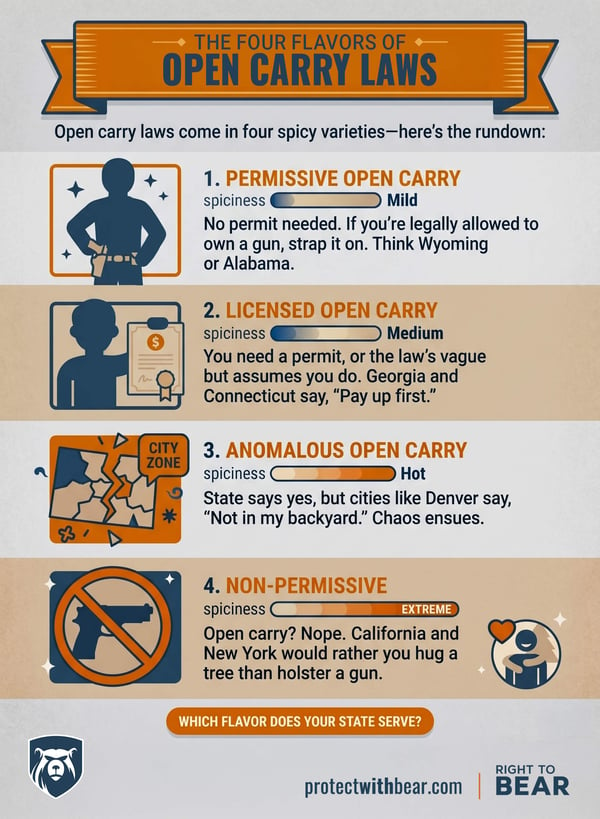
Permitless open carry (35 states): Alabama, Alaska, Arizona, Arkansas, Florida, Georgia, Idaho, Indiana, Iowa, Kansas, Kentucky, Louisiana, Maine, Mississippi, Missouri, Montana, Nebraska, Nevada, New Hampshire, New Mexico, North Carolina, North Dakota, Ohio, Oklahoma, South Carolina, South Dakota, Tennessee, Texas, Utah, Vermont, Virginia, Washington, West Virginia, Wisconsin, and Wyoming.
Permitless, but local rules or conditions matter more (5 states): Colorado, Delaware, Michigan, Oregon, and Pennsylvania. Wikipedia calls states like these “anomalous.” Cities such as Denver and Portland can restrict open carry, and Pennsylvania requires a license in Philadelphia. Age rules for Delaware differ across sources, so check the statute.
License required (5 states): Hawaii, Maryland, Massachusetts, Minnesota, and Rhode Island.
Prohibited or heavily restricted: California, Connecticut, Illinois, New Jersey, New York, and the District of Columbia.
A few details that trip people up:
- Georgia: SB 319, signed in April 2022, generally allows a “lawful weapons carrier” to carry openly or concealed in most public places without a license.
- South Carolina: H.3594, signed March 7, 2024, allows people not otherwise prohibited, age 18 and older, to carry openly or concealed without training or a permit.
- Connecticut: Under Public Act 23-53, effective October 1, 2023, carrying a firearm with intent to display it in public is generally prohibited. Exceptions are narrow, such as your own property or business, or with the owner’s express permission. A standard carry permit does not authorize ordinary open carry.
- Texas: Permitless handgun carry is tied to age 21, and the handgun must be holstered.
- Washington: Open carry is lawful without a permit, but carrying a loaded handgun in a vehicle requires a concealed pistol license.
What Changed in 2025 and 2026?
The biggest changes came from the courts, not legislatures. Florida’s open carry ban was struck down in 2025, California’s urban ban is back before the full Ninth Circuit, and the Supreme Court weighed in on a related Hawaii carry rule in June.
- Florida: In McDaniels v. State (September 10, 2025), Florida’s First District Court of Appeal held the open carry ban, § 790.053, unconstitutional. The Attorney General’s September 15, 2025 guidance told law enforcement to stop enforcing it. The statute is still printed and unrepealed, 2026 cleanup bills died in committee in March, and only one district has ruled. Open carry is lawful in practice because of a court ruling and an enforcement directive, not a new law. A separate case, Eubanks v. State (4th DCA, June 17, 2026), concerns concealed carry for ages 18 to 20, not open carry.
- California: In Baird v. Bonta, a Ninth Circuit panel struck down the open carry ban for counties over 200,000 people on January 2, 2026. On April 15, the court vacated that opinion and ordered a rehearing en banc, which was argued June 3. California says its restrictions remain in effect, and we have not seen an en banc decision, so treat it as unresolved.
- Wolford v. Lopez (June 25, 2026): The Supreme Court took up Hawaii’s private-property default rule and wrote that the Second Amendment “has the same meaning in all parts of the United States.” It matters more for where licensed carriers can go than for open carry itself.
Do You Need a Permit to Open Carry?
In about 40 states, no. An adult who isn’t legally prohibited can generally carry a handgun openly without a permit. A handful of states require a license, and a few effectively don’t allow open carry at all.
An open carry permit is also not the same thing as a concealed carry permit. Some states issue one license that covers both, some cover only concealed carry, and some require nothing at all for open carry. Age rules vary too: Texas ties permitless handgun carry to 21, while South Carolina allows it at 18. For more on permits generally, see our guide to how to get a concealed carry permit.
Where Can You Not Open Carry?
Even in the most permissive states, open carry is off-limits in many places, and private property owners can usually say no. Common restricted places include schools, courthouses, polling places, airport terminals, and many government buildings, and federal law adds its own limits.
A few other things apply almost everywhere:
- Brandishing and menacing laws. Carrying openly is not a defense if your behavior is threatening.
- Duty to inform. Some states require you to tell an officer you’re armed during a stop. Check your state’s page for the rule.
- Long guns. Rules for rifles and shotguns often differ from handguns, and some permissive states treat them differently, including for age and loading.

Open Carry vs. Concealed Carry
Neither is better in every situation. Each trades visibility for other practical considerations.
|
Open Carry |
Concealed Carry |
|
|
Visibility |
Visible to others |
Hidden from view |
|
Permit rules |
Often none in permissive states |
Often none in permitless states, a permit elsewhere |
|
Police contact |
May draw attention or questions |
Usually less visible to the public |
|
Practical issues |
Retention, store and property policies |
Holster and clothing choices |
Is Open Carry the Same as Constitutional Carry?
No. Constitutional carry means you don’t need a permit. Open carry means the firearm is visible. A state can allow one without the other, and many permitless states allow both. For the full list, see our guide to constitutional carry states.
Do Open Carry Rules Change If You Carry in More Than One State?
Yes, and often at the state line.
Reciprocity covers concealed carry, and it rarely covers open carry the way people assume, so a permit that’s valid next door may not let you carry openly there. Check each state you’ll pass through, starting with our reciprocity map and the relevant state pages.
Knowing where you can carry is only half of the picture. Your legal protection is a separate question, and it doesn’t automatically follow you across a state line. If you ever had to use a firearm in self-defense away from home, you’d be dealing with prosecutors, courts, and use-of-force laws you may never have dealt with before, and the legal exposure would start right away.
A Right To Bear membership includes access to CCW insurance* for legal protection after a covered act of self-defense. For people who carry beyond their home state, members can add Multi-State Protection for $4 a month or $35 a year, an add-on that extends legal protection* to all 50 states. It’s about legal defense, not permit validity. It doesn’t change where you’re allowed to carry, but it can mean your protection is with you where the incident happens.
It also starts with a phone call. Every member has access to an attorney-answered hotline for both emergency and non-emergency matters, available 24/7/365. In an emergency, one call establishes attorney-client privilege, so you can get real answers in real time on things like how to speak with investigators and what to do if you’re arrested. For non-emergencies, members can reach a qualified attorney with legal questions before an incident ever happens, including questions about a trip before you take it.
Learn more about CCW insurance and Multi-State Protection, then check out the rest of our benefits. Sign up for a Right To Bear membership today starting at $19/month for an individual membership.
*All coverage and benefits are subject to the terms, conditions, and exclusions of the self-defense liability policy.
Frequently Asked Questions
How many states allow open carry?
By our count, 40 states allow adults who aren’t legally prohibited to openly carry a handgun without a permit as of November 12, 2026. Five require a license, and five plus D.C. ban it or restrict it heavily. Other tallies differ based on how they count handguns, ages, and local limits.
Is open carry legal in Florida?
Yes, in practice. A 2025 appeals court ruling struck down the ban, and the Attorney General told police to stop enforcing it. The statute is still printed and unrepealed, though, and only one district has ruled, so the status could change.
Is open carry legal in California?
Mostly no. Open carry of a loaded handgun is generally prohibited, and open carry is banned in counties over 200,000 people. A Ninth Circuit panel struck that ban down in January, but the full court is rehearing the case, so the restrictions remain in effect for now.
Can you open carry without a permit?
In about 40 states, yes, for adults who aren’t legally prohibited. Others require a license or don’t allow open carry at all. Age, location, and handgun versus long gun rules vary.
Can you open carry in a car?
It depends on the state. Some treat a handgun in a vehicle as concealed, some require it to be unloaded or cased, and some, like Washington, require a license for a loaded handgun in a vehicle. Check your state before you drive.
What is the difference between open carry and constitutional carry?
Open carry is about visibility, meaning the firearm can be seen. Constitutional carry is about permits, meaning you don’t need one. A state can allow either or both.
Can a business ban open carry?
Generally, yes. Private property owners can usually prohibit firearms, and carrying after being told to leave can lead to a trespass charge. Some states give posted signs the force of law, so check your state’s rules.