ATF No Longer Enforcing Needing Approval For Adding Stock to Pistols
Gun Owners Should Still Read the Fine Print
ATF Director Robert Cekada signed an open letter announcing that the agency will no longer require approval or registration under the National Firearms Act for short-barreled rifles, short-barreled shotguns, silencers, and “any other weapons” on Friday, Oct. 9.
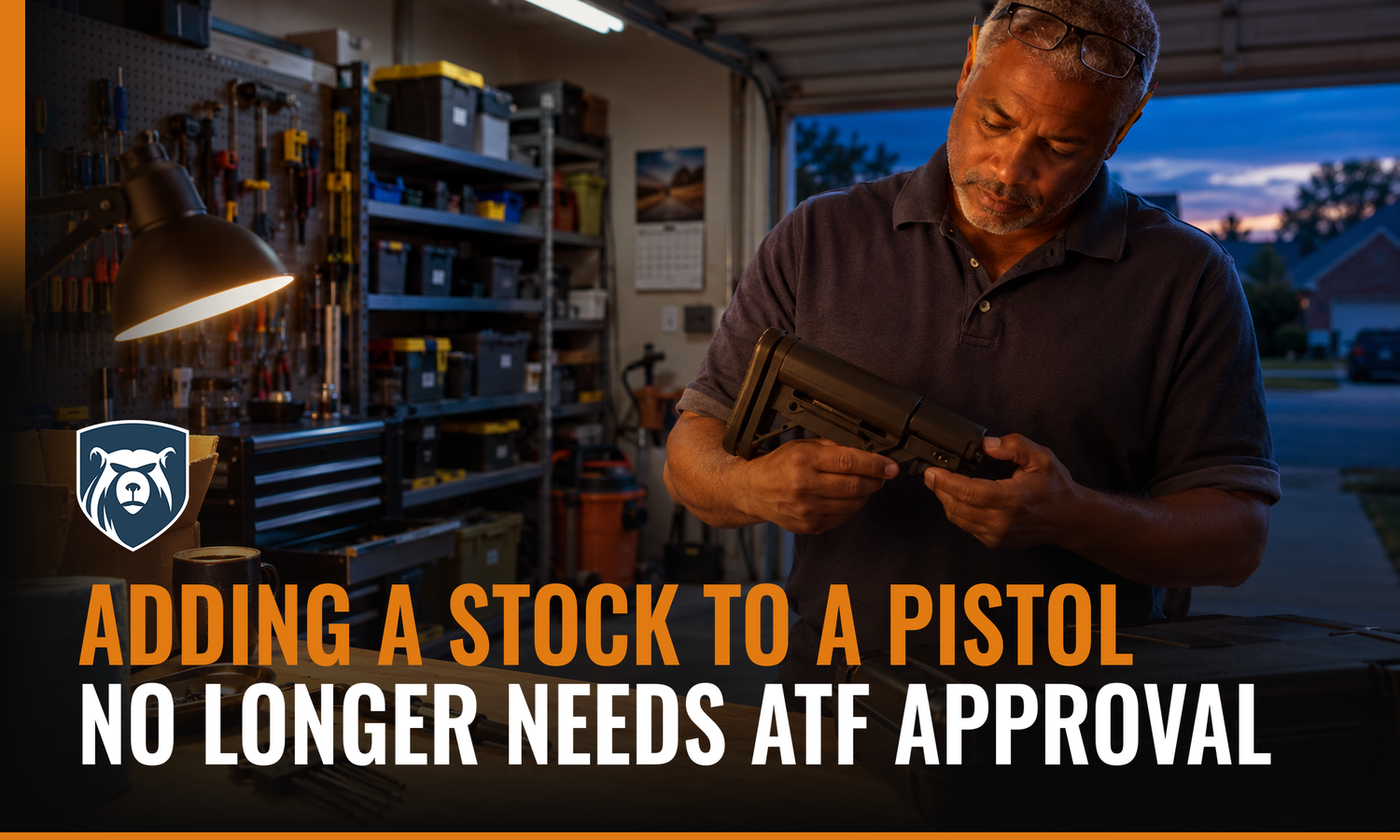
The headline most people will take from it is about suppressors. The part most likely to start arguments, and to get ordinary gun owners into trouble, is what it means for a pistol with a stock on it.
Want more content like this?
Stay connected with the latest news, updates, and special offers. Join our community by signing up for our newsletter today!
The Letter Doesn’t Say “Pistol Stock” But It Might As Well
The open letter never mentions pistols or stocks. It says ATF “will no longer require individuals to seek ATF approval under the NFA before making or transferring” short-barreled rifles, and that those items no longer have to be registered.
The connection comes from how federal law defines “making.”
Under the NFA, putting together or altering a firearm so that it becomes a short-barreled rifle counts as making one. A pistol with a barrel under 16 inches that is configured with a shoulder stock can fall into that category.
For decades, doing that without an approved Form 1 and a tax stamp was a potential felony. Under the new enforcement policy, ATF says it will not require that approval or registration. Industry coverage reached the same reading, noting that pairing a short-barreled upper with a stocked lower no longer requires an approved Form 1 federally.
The ATF’s own companion FAQ is the authoritative place to see how the agency applies it to specific builds.
Is it a Pistol or a Short-Barreled Rifle?
For years, the line between a pistol and a short-barreled rifle has been one of the most contested lines in federal firearms law. Gun owners complained that the distinction depended on a stock, a brace, or a few inches of barrel, and that crossing it by accident could carry up to ten years in prison.
Critics of the NFA called it the clearest example of an arbitrary rule.
Supporters of strict regulation argued the opposite: that those distinctions exist because short, shoulder-fired rifles are easier to conceal and more dangerous at close range.
The letter does not settle that argument, but rather sidesteps it. The government has stopped requiring the paperwork while leaving the statute on the books.
In practice, a lawful owner can add a stock to a pistol without asking permission in advance, but the law that makes it an NFA firearm has not been repealed.
The Five Limits That Matter More Than the Headline
The open letter is careful about what has not changed, and anyone considering a pistol-to-SBR build should treat those limits as the real instructions.
- State law still controls. The letter says the policy does not affect state or local laws governing NFA weapons, and it notes that most states have general criminal prohibitions on some or all NFA items, often with exceptions for items possessed in compliance with or registered under federal law. That exception is exactly what a lot of owners will lose if they never register. California, for example, makes it a crime to make or possess a short-barreled rifle outside narrow exceptions. A federal non-enforcement policy is no defense in a state courtroom.
- Transporting a short-barreled rifle still has rules: The ATF says people transporting SBRs should keep filing Form 20s, even if the firearm is unregistered.
- The letter also warns that it is unclear whether state courts will apply the federal safe-passage protection of 18 U.S.C. § 926A to unregistered NFA items, and it tells owners to be cautious about driving through states where such items are prohibited.
- Prohibited persons are still prohibited: The letter says the Gun Control Act’s background check and recordkeeping requirements remain, and that these items cannot be possessed by prohibited persons.
- Machine guns and destructive devices are untouched: Only the four categories that Congress taxed at $0 are covered. Adding a stock to a pistol does not change that. Anything that crosses into a machine gun is a different matter entirely.
- Businesses still pay the special occupational tax: Dealers and manufacturers are not off the hook.
Enforcement Discretion Is Not Law
The most important thing to understand about this letter is it is only a statement about what the ATF will choose not to enforce. It is not a court order, and it does not repeal anything.
A district judge in Texas held that the underlying registration requirements exceed Congress’s powers, but the injunction itself covers only the plaintiffs and certain connected parties. ATF extended the practical benefit to everyone through policy, and the letter says so directly.
Policy can change. A future administration could announce a different enforcement posture, and the statute would still be there.
The letter itself describes ATF administering the NFA “on a voluntary basis,” continuing to accept Form 1 applications for those who want their item registered.
For someone building an SBR out of a pistol, that voluntary registration may turn out to be the more careful choice, especially for anyone who lives in or travels through a state with its own rules, or who wants a record that the build was made lawfully while the policy was in effect.
What This Means for Gun Owners
Federal approval is no longer the gate it was on October 8. State law, transport rules, and the Gun Control Act’s sale restrictions remain, and a policy memo is a thin shield against any of them.
For the many gun owners who have been frustrated by the pistol-versus-rifle line for years, the letter is a real change. For anyone who treats it as a green light everywhere, it is also a trap.
In this age of modern politics, legislators look for the easy win. What decision can they make that will appease the most people in the shortest amount of time. This is blatantly one of those decisions. Those with very real gripes about what constitutes a pistol versus a SBR might see this as a victory, and it is, but it could very well be a temporary one.
In a few years, a largely pro-gun control legislative body could just as easily target this quick win for their own bit of constituency appeasement by reversing it and seeking to re-shape legislation once more. While this is a next step towards parity of the shoe-knot of gun law that sprawls across 50 states and an untold amount of paper, it is not permanent. Not yet at least.
For those who are looking to add a stock to their pistol, by all means this is your sign, but be aware that one day enforcement may start again and with one stroke of a pen your once-legal firearm might come under scrutiny once more and leave you holding an “illegal” piece of equipment.
PURE PEACE OF MIND STARTS HERE
Protect your freedom with steadfast legal defense built for everyday carriers. Become a Right To Bear member today.