Bail can be set within hours of a self-defense arrest, and in serious use-of-force cases, that number can reach six figures before your family has had time to process what is happening. Right To Bear's optional Bail Bond Benefit add-on provides up to $100,000 toward bail bond expenditures, but what does that actually mean in real-world dollars and real-world situations?
At Right To Bear, we built the Bail Bond Benefit add-on because we understand that the hours immediately following an arrest are not just emotionally overwhelming, but are strategically critical to your defense. Whether you are fighting your case from home or from a cell can directly affect the quality of your defense.
See Also: How Do Bail Bonds Work?
How Much Does Bail Actually Cost?
Bail is a financial guarantee to the court that you will return for your scheduled appearances. The amount is set by a judge at arraignment and reflects the severity of the charges, not the eventual outcome of the case.
In use-of-force cases, bail amounts can be significant even when a strong self-defense claim exists, because the initial charge level determines the bail range, not the circumstances the defense will later present. Here is a general framework for what bail looks like in these situations:
|
Charge Type |
Typical Bail Range |
|
Aggravated Assault |
$20,000 to $100,000+ |
|
Manslaughter |
$50,000 to $250,000+ |
|
Homicide |
Often denied or $250,000+ |
Bail can reach six figures even when self-defense is clearly claimed, and most families cannot produce that kind of cash on short notice. This is the exposure the Bail Bond Benefit add-on is designed to address.
Cash Bail vs Bail Bond: What Is the Difference?
There are two primary ways to secure release after an arrest, and they work very differently.
Posting full cash bail means paying the entire bail amount directly to the court. This money is refundable at the conclusion of the case if all court appearances are honored, minus administrative fees. The problem is liquidity. A $100,000 cash bail requirement means $100,000 out of your accounts immediately, a barrier most households simply cannot clear.
Using a bail bond is the more common path. You pay a licensed bondsman approximately 10 percent of the total bail as a non-refundable premium, and the bondsman posts the full bail amount with the court on your behalf. Here is what that looks like:
- Bail set at $100,000
- You pay the bondsman approximately $10,000
- The bondsman posts $100,000 with the court
- You are released pending trial
The important clarification is that the 10% premium is not refunded under any circumstances, even if charges are dismissed the following week. It is the cost of release, not a deposit against the outcome.
How Bond Percentages Work
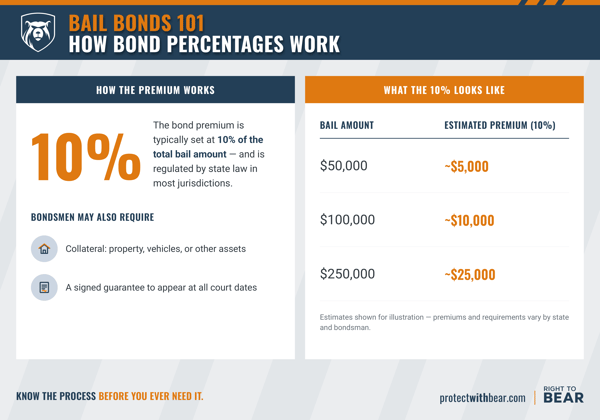
The bond premium is typically set at 10% of the total bail amount and is regulated by state law in most jurisdictions. In addition to the premium, bondsmen may require collateral in the form of property, vehicles, or other assets, and a signed guarantee that you will appear for all required court dates.
Here is what the 10% premium looks like across different bail amounts:
|
Bail Amount |
Estimated Premium (10%) |
|
$50,000 |
~$5,000 |
|
$100,000 |
~$10,000 |
|
$250,000 |
~$25,000 |
The premium is due immediately. It is also entirely separate from the attorney retainer your defense counsel will require to begin representation. These two costs arrive at the same time, compounding the financial pressure families face in the first 24 to 72 hours after an arrest.
What $100,000 Bail Bond Coverage Actually Covers
This is where clarity matters most. The Bail Bond Benefit add-on provides up to $100,000 toward bail bond expenditures following a covered self-defense incident. This is not a direct cash payment deposited into your account. It is coverage applied toward the bail bond obligation itself, designed to remove the liquidity crisis that bail creates for most families.
In practical terms, this means:
- The financial barrier to release is addressed without forced asset liquidation
- You are not dependent on what you happen to have liquid at the moment of arrest
- Release can happen faster, which has direct strategic implications for your defense
- Family members are not scrambling to come up with funds while also managing the emotional weight of the situation
Coverage is capped at $100,000. It is not unlimited. Cases where bail exceeds that amount may carry additional exposure depending on the bond structure. But for the majority of self-defense arrest scenarios, the coverage addresses the core financial barrier to getting home quickly.
Real-World Cost Scenarios
Scenario 1: Bail set at $50,000. The bond premium runs approximately $5,000. Without coverage, that is an out-of-pocket payment due immediately on top of whatever attorney retainer is required. With coverage, the bond obligation is addressed, release is secured faster, and the family's liquidity stays intact.
Scenario 2: Bail set at $100,000. The bond premium runs approximately $10,000. Without coverage, families are often scrambling to liquidate savings, call relatives, or put up property as collateral while the clock runs. With up to $100,000 in bail bond coverage, this scenario is addressed within the coverage cap, providing significant liquidity protection and accelerating release.
Scenario 3: Bail set at $250,000. The bond premium runs approximately $25,000. Coverage applies up to the $100,000 cap, which addresses a significant portion of the obligation. Depending on the specific bond structure and jurisdiction, some additional exposure may remain. Coverage in this scenario still provides meaningful financial relief, but families should understand the cap and plan accordingly.
When Is a Bond Forfeited?
Release on bail is conditional, not permanent, and understanding the conditions that can trigger forfeiture is important. Common triggers include:
- Failure to appear for a scheduled court date
- Violation of the specific conditions of release
- Fleeing jurisdiction while on bond
If a bond is forfeited, the consequences are serious. An arrest warrant is typically issued immediately. Additional criminal charges may follow. Financial penalties apply, and any collateral used to secure the bond can be seized. Release on bail is not immunity from consequences. It is a structured agreement with real obligations attached to it.
Conditions of Pretrial Release
When bail is granted, the court typically attaches conditions to that release. Common conditions in use-of-force cases include mandatory appearances at all scheduled court dates, travel restrictions limiting where you can go, no-contact orders related to parties involved in the incident, and in many cases, firearm restrictions during the pretrial period.
Bail buys time to prepare your defense from outside a cell. It does not mean the case is resolved or that normal life simply resumes. Understanding and strictly complying with release conditions is essential to keeping that release intact.

Why Bail Access Matters Strategically
The difference between being released quickly and spending days or weeks in custody is not just about comfort. It has direct strategic consequences for your defense.
Time in custody affects your ability to coordinate with your attorney in real time, preserve physical evidence while it is still available, identify and reach witnesses before memories fade, maintain employment during what may be a lengthy pretrial period, and provide stability for your family during an already overwhelming situation.
The first 48 to 72 hours after an arrest are the most strategically important window of the entire legal process. Fast release is not a convenience. It is a tactical advantage that directly influences the quality of the defense you are able to build from the very beginning.
How This Fits Into Full-Spectrum Self-Defense Legal Protection
The Bail Bond Benefit add-on is one piece of a broader protection structure. Post-incident legal exposure after a self-defense shooting includes criminal charges, civil lawsuits, bail costs, expert witness fees, and lost wages, often arriving simultaneously and all requiring financial resources immediately.
Right To Bear's membership addresses these exposures across multiple layers:
- Criminal Defense Protection covering 100% of attorney fees for a covered incident including any appeal
- Civil Defense Protection covering 100% of attorney fees for civil lawsuits and appeals arising from the same incident
- The optional Bail Bond Benefit providing up to $100,000 toward bail bond expenditures
- A 24/7/365 emergency attorney hotline answered by real attorneys
- Lost wage reimbursement of up to $300 per day with a $2,500 per incident cap
- Expert witness coverage
- Firearm replacement if your weapon is seized as evidence
- Red Flag Law protection providing up to $25,000 toward attorney fees if your weapon is seized under an Emergency Risk Protection Order
- Up to 40 counseling sessions for psychological support after a covered incident
These protections are designed to work together, because the legal aftermath of a self-defense incident rarely involves just one kind of exposure.
Do You Actually Need Bail Bond Coverage?
Without preparation, securing release after a self-defense arrest may require liquidating savings, drawing on retirement accounts, asking family members to provide collateral, or remaining in custody while those options are explored.
Each of those paths comes with its own set of financial, emotional, and strategic costs.
With preparation, release becomes a function of your coverage rather than your available liquidity in that specific moment. The financial shock is absorbed. Release happens faster. Your defense begins on solid footing rather than in crisis mode.
Preparation creates optionality. The absence of it removes it at exactly the moment you need it most.
Who Should Consider the Bail Bond Add-On?
The Bail Bond Benefit add-on is particularly relevant for anyone in a high-bail state where six-figure bail amounts are common in serious charge categories, anyone without significant liquid assets that could be accessed on 24 hours notice, multi-state carriers whose legal exposure can arise in any number of jurisdictions, and anyone seeking full-spectrum legal protection that addresses every point of financial exposure after a self-defense incident.
Bail exposure is not theoretical for responsible carriers. It is a predictable part of the legal aftermath that should be planned for the same way every other part of that aftermath is planned for.
Get Protected Before You Ever Need It
Bail can reach six figures within hours of a self-defense arrest. The Bail Bond Benefit add-on provides up to $100,000 toward that obligation, addressing the liquidity crisis that bail creates for most families and ensuring that your defense begins from home rather than from a holding cell. Combined with criminal and civil defense protection, emergency attorney-answered hotline access, and the full suite of Right To Bear membership benefits, it completes a protection structure built around every part of what happens after a defensive incident, not just the moment of defense itself.
Coverage must be active before an incident occurs. You cannot add the Bail Bond Benefit from a holding cell any more than you can arrange homeowners insurance while your house is burning. Sign up today and make sure every layer of protection is already in place before you ever need it.
Frequently Asked Questions
Does the $100,000 mean I receive $100,000 in cash?
No. The coverage applies toward bail bond expenditures following a covered self-defense incident, subject to the terms of the benefit. It is not a direct cash payment but rather coverage designed to address the bail bond obligation itself.
What if bail exceeds $100,000?
Coverage applies up to the $100,000 cap. In cases where bail is set above that amount, some additional exposure may remain depending on the bond structure and jurisdiction.
Is the 10 percent bond premium refunded?
No. Bail bond premiums are non-refundable regardless of the outcome of the case. Even if charges are dismissed, the premium paid to the bondsman is not returned.
Does bail bond coverage replace criminal defense coverage?
No. The Bail Bond Benefit add-on is a separate protection that complements criminal and civil defense coverage. It addresses the cost of securing release, while criminal and civil defense coverage addresses attorney fees for the legal proceedings that follow.
Can I add the Bail Bond Benefit after an incident occurs?
No. All coverage must be active before an incident occurs. Protection cannot be activated retroactively once an arrest has taken place.